If something tore up your Edmonton lawn overnight, a skunk is the likely culprit. Skunks dig in late summer and fall, when beetle grubs sit near the surface. They do the work in the dark (Iowa State University Extension). This guide covers why skunks target Edmonton lawns in fall and how to tell their digging from grub damage.
Key Takeaways
- → Skunks tear up lawns at night in fall while hunting white grubs and earthworms (Iowa State University Extension).
- → Just 5 grubs per square foot can draw skunks. Healthy turf tolerates 20 or more before it shows damage (Iowa State University Extension).
- → You can trap skunks on your own Edmonton property, but relocating one means moving it 15 km away (City of Edmonton).
- → Skunks warn before spraying. Stamped front paws, hissing, and a raised tail all mean back away slowly (Alberta.ca).
Why Do Skunks Dig Up Edmonton Lawns in Fall?
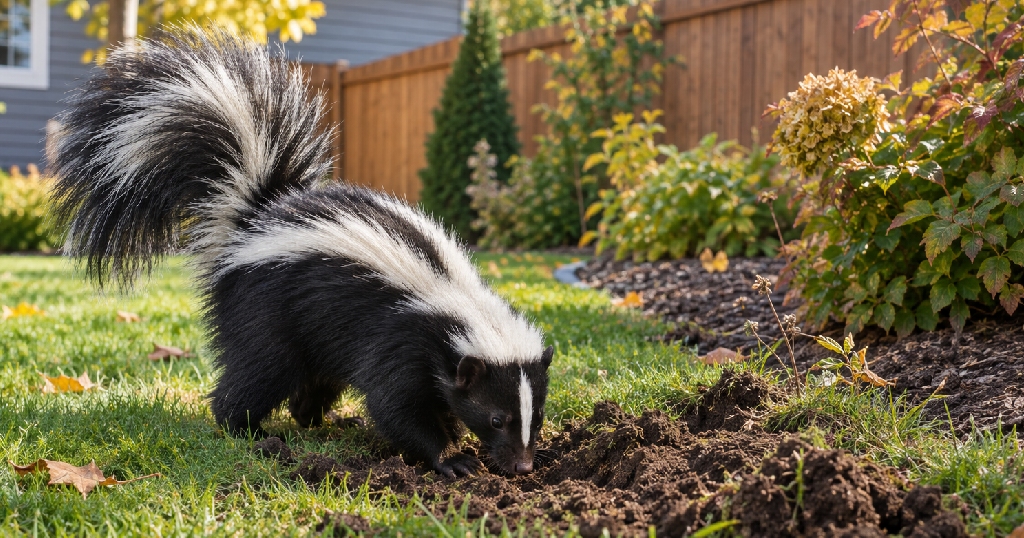
Skunks dig up lawns in fall because grubs and earthworms move within a few inches of the surface at night. Iowa State University Extension describes the method. A skunk pushes its nose into turf, then scoops with its front paws, leaving loose holes that merge into one patch. That’s the giveaway.
Those grubs are beetle larvae. May and June beetle species feed on grass roots into mid-October. They then burrow 6 to 18 inches down for winter (University of Maryland Extension). That window fits Edmonton’s long, frost-free fall, when soil is still workable and skunks keep digging past the first cold nights.
Grubs aren’t the only draw. Skunks feed heavily on insects and rodents such as mice. They’ll also empty a pet dish, a compost bin, or a bird feeder spill (Alberta.ca). Skunks don’t truly hibernate. They go inactive in the coldest weeks of winter. Fall is their last big feeding window.
In our fall service calls, the torn-up patch usually sits at the lawn edge nearest a deck or shed. The den is metres away, not across the yard. Fix the lawn and you still have the skunk.
Is It Grub Damage or Skunk Damage?
Grub damage and skunk damage leave different signatures. Grubs chew grass roots, so turf thins, yellows, and feels spongy underfoot. Badly hit sections lift away like carpet (University of Maryland Extension). Healthy turf handles 20 or more grubs per square foot before it shows injury.
Skunks dig shallow, cone-shaped holes hunting those same grubs. They can strip a patch in one night (Iowa State University Extension). Raccoons peel sod back in neat sections. The pattern is the clue.
| Damage | What You See | Usual Culprit |
|---|---|---|
| Cone-shaped holes | Loose turf rolled aside, roots attached, dug overnight. | Skunk |
| Spongy, yellowing turf | Turf lifts like carpet, C-shaped grubs underneath. | White grubs |
| Sod flipped in sections | Turf rolled back like a rug, with little loose soil. | Raccoon |
| Small punctures or ridges | Beak-sized holes, or soft tunnels with no holes. | Crows, moles, voles |
To confirm grubs, cut a square foot of turf two inches deep and count the larvae underneath (Iowa State University Extension). Five or more grubs per square foot is enough to bring skunks back each night. Curative insecticide treatments work best in August and early September. They aren’t effective after early October. Not sure who’s visiting? Our guide to the 5 most common pests in Edmonton covers each one.
What Actually Deters Skunks From Your Yard?
Deterrence works best when you remove food and shelter, not when you scare skunks away. Alberta.ca is blunt: to stop new skunks from visiting, you must remove the food or shelter they’re seeking. Canada also has no registered skunk repellents (City of Edmonton).
| Deterrent | Does It Work? | What to Know |
|---|---|---|
| Remove food and shelter | Yes, most reliable | Tight-lidded bins, indoor pet food, cleared brush (Alberta.ca). |
| Low wire fencing | Yes | Skunks are poor climbers, so a pinned fence holds. |
| Buried hardware cloth | Yes, for dens | Half-inch mesh, 12 inches deep, angled outward. |
| Lights and radio noise | Partly | Makes the yard less appealing, but skunks adapt. |
Start with exclusion. Skunks don’t jump or climb well. A sturdy wire fence pinned to the ground keeps them out of a garden bed or a prized patch of grass (Alberta.ca). For a den under a deck, shed, or porch, use half-inch hardware cloth buried 12 inches deep and sloping outward (City of Edmonton). Check it’s empty first.
Then cut the buffet. Feed pets indoors. Store the food inside. Use bins with tight-fitting lids, and sweep up spilled birdseed. Clear brush piles, stacked lumber, and debris that give skunks cover (Alberta.ca). Motion lights and a radio help at the margins. Nothing worth visiting beats every deterrent.
Same patch torn up every morning? A local inspection finds the den and the grubs behind it.
Skunk Spray Is a Safety Issue, Not Just a Smell
Skunk spray is a chemical irritant, and it deserves respect. Alberta.ca notes it causes watering eyes, nasal irritation, and nausea. It has blinded people for up to 15 minutes. A skunk warns first by stamping its front paws, growling, raising its tail, and hissing. Back away slowly and quietly.
For a sprayed pet, skip the tomato juice. Mix one quart of 3 percent hydrogen peroxide, a quarter cup of baking soda, and a teaspoon of liquid dish soap in an open container (Penn State Extension). Use it right away. Work it into the coat, avoid the eyes, let it sit five minutes, then rinse. If a pet is sprayed often, our guide to pest control that is truly safe for pets and children covers what to avoid.
Rabies deserves a straight answer. Skunks are among the animals that most often transmit rabies in Canada (Canadian Food Inspection Agency). Skunk rabies isn’t found in Alberta, though, and the last rabid skunk here was in 1994 (Alberta.ca). Flag odd behaviour. A skunk out in daylight or unafraid of people should be reported to Alberta Fish and Wildlife or 311.
When Should You Call a Professional for Skunk Removal in Edmonton?
Call a licensed professional when a skunk dens under a deck, shed, or porch. Call too when the same lawn gets wrecked twice, or when you can’t find the entry point. Trapping skunks is legal on your own property. The City of Edmonton advises relocating one at least 15 km from the capture site (City of Edmonton).
Relocation brings side effects that don’t show up on paper. Traps don’t choose their catch, and baited traps draw more animals. A trapped mother can leave orphaned kits behind. Relocated skunks face territorial fights, trouble finding food, and a higher chance of spreading disease (City of Edmonton). Pull the animal without pulling the attraction and you’ve opened the den for the next one.
A professional handles the parts that are hard to do safely. That means finding the den and confirming it’s empty before sealing it, excluding with 12-inch-deep hardware cloth, and treating the lawn. It also means knowing when a skunk is a wildlife case, not a pest case.
Two numbers worth saving: report problem wildlife through Animal Care and Control at 311. Call WILDNorth at 780-914-4118 for injured or orphaned wildlife. A skunk inside a garage, window well, or crawlspace needs the right equipment. Corners and improvised traps are how people get sprayed.
Stop the Digging Before the Frost Sets In
Fall lawn damage in Edmonton is usually a skunk working a grub patch in the dark. You’ll know it by the cone-shaped holes and rolled-aside turf. Count the grubs first. Then seal under decks and sheds with buried hardware cloth, move pet food and garbage out of reach, and press the lifted sod back down. Fall is the best season to repair that turf (Iowa State University Extension).
If the digging keeps coming back, or a skunk has moved in under your deck, it’s time for help. See our guide to when to call a professional exterminator in Edmonton, or our rundown of pest control companies serving Edmonton.
Call (587) 568-9403 or Get Help With Skunks Today