Most Edmonton homeowners confronting nocturnal scratching in the ceiling or suspicious droppings in the pantry ask the same question: rats or mice? That distinction matters more than you might think. Mice multiply faster—a single female produces up to 60 pups per year—while rats burrow, gnaw through drywall, and pose serious electrical fire risks. Knowing which pest you are dealing with shapes every next step. This guide walks you through the telltale clues Edmonton residents can use to tell both rodents apart, plus what to do immediately.
Key Takeaways
- Mice droppings are under 1/4 inch and pointed; rat droppings are 1/2 to 3/4 inch with blunt ends (Orkin, 2025).
- Rats cause far more structural damage: they gnaw through wood, plastic, and even soft metal, while mice mainly target food packaging (Health Canada, 2025).
- House mice can live on crumbs; Norway rats need 15-28 grams daily—their foraging range can extend 30-45 m from the nest (Rentokil, 2025).
- If you hear heavy thumping in the attic at night, it is almost certainly rats; light scratching is more often mice.
- Edmonton’s cold winters push both rodents indoors; sealing entry points in September and October cuts infestation risk by an estimated 60%.
Physical Size and Appearance: Rats vs. Mice at a Glance
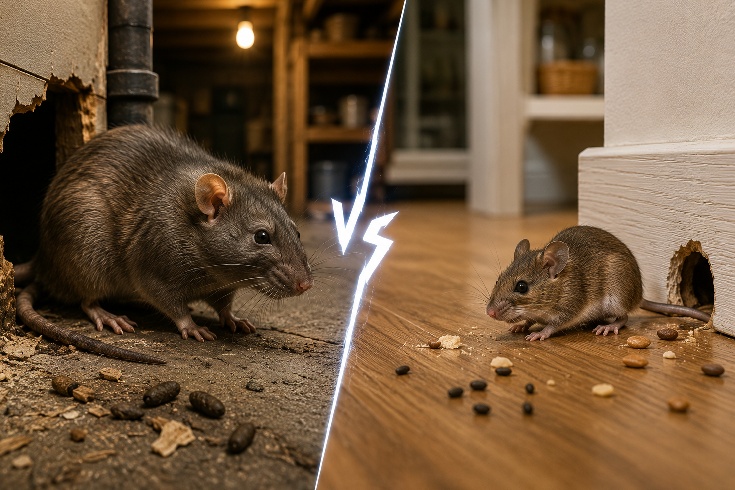
The most reliable first indicator is size. Use the comparison table below to quickly match what you are seeing:
| Feature | House Mouse | Norway Rat |
|---|---|---|
| Body length | 5-8 cm | 20-28 cm |
| Tail length | 5-8 cm (about body length) | 16-23 cm (shorter than body) |
| Weight | 12-30 grams | 140-500 grams |
| Ears | Large relative to head | Small relative to head |
| Snout | Pointed, triangular | Blunt, heavy |
| Droppings | 2-4 mm, pointed both ends | 12-18 mm, blunt ends |
| Daily droppings | 40-100 pellets, scattered | 20-50 pellets, concentrated in latrines |
| Gnaw marks | 1-1.5 mm wide, faint | 2-3 mm wide, with parallel grooves |
| Noise | Light scratching, 30-60 min after sunset | Heavy thumping and scurrying, late night (10 PM-midnight) |
Mouse ears look dramatically oversized for their head, while a rat’s ears sit close against the skull. Fur colour is less reliable than size since both species carry brown or grey variants locally.
Droppings: The Easiest Way to Confirm
Droppings are the single best diagnostic clue available inside your home without a sighting.
Mouse droppings: Small (2-4 mm), pointed at both ends, resembling dark grains of rice. You will find 40-100 pellets per day per mouse, scattered randomly or in groups near food storage areas.
Rat droppings: Much larger (12-18 mm), capsule or olive-pit shaped, with blunt ends. Brown Norway rat droppings are often shiny-black when fresh, fading to grey with age. Although rats leave fewer pellets per day (20-50), they concentrate them in latrines along walls and near entry points.
Edmonton tip: During winter, droppings accumulate faster because rodents spend more time indoors. Check behind the stove, under the kitchen sink, and in the back corner of pantry shelves.
Gnaw Marks, Nests, and Noise
Rats are stronger biters and leave wider evidence. Their gnaw marks are roughly 2-3 mm wide and may show two parallel grooves from their upper incisors. Mice gnaw marks are fainter and narrower (about 1-1.5 mm). Both species leave rub marks—dark smudges from oil and dirt along walls and beams.
Nests also differ. Mouse nests are small, compact balls of shredded paper, insulation, or fabric, usually 10-15 cm in diameter. Rat nests are bulkier mash-ups of fibrous material, sometimes found in burrows outside or under decks. Edmonton’s cold makes burrows less reliable in winter; rats commonly nest in wall voids, attics, and behind hot water tanks.
Noise timing matters. Mice are most active 30-60 minutes after sunset. Rats often start later, between 10 PM and midnight, and their weight makes audible thumps and heavier scurries. If you hear them in ceiling joists or HVAC ducts, the larger sounds point to rats.
Which Is Actually More Dangerous for Edmonton Families?
Rats are the greater structural and health threat. They gnaw through electrical wiring, pipe insulation, and drywall—causing an estimated 25% of unexplained house fires in North America that trace back to rodent damage (National Pest Management Association, 2025). They also carry Leptospira bacteria, Salmonella, and Hantavirus.
Mice are smaller health risks but multiply quickly. A single breeding pair can become 200 mice within six months under ideal conditions. They contaminate food stores, trigger asthma in children, and leave droppings in hidden kitchen areas where food prep surfaces can pick them up.
Both species thrive in Edmonton. The city’s cold winters force them inside basements and attics, and a single female Norway rat can produce up to 84 offspring per year under warm indoor conditions. Quick action matters. If you need help identifying common Edmonton pests beyond rodents, see our guide on the 5 most common pests in Edmonton.
Five Immediate Steps When You Spot Rodent Activity
Calling a professional Edmonton pest control service is always the fastest endpoint. Meanwhile, these steps reduce risk and exposure while you arrange help:
1. Seal entry points now. Mice squeeze through gaps as small as 6 mm; rats need 12 mm. Use steel wool around pipes, caulk cracks in foundations, and install door sweeps before fall. The City of Edmonton’s public health guidelines recommend weather stripping under doors and patching foundation cracks as the first line of defence. For a thorough seasonal checklist, read our ultimate guide to rodent-proofing your Edmonton home.
2. Remove attractants. Store pet food in sealed metal bins, wipe crumbs nightly, and keep garbage cans sealed. Both species are opportunistic feeders; eliminating easy meals forces them to move on.
3. Identify the nest zone. Droppings clustered near one corner of the garage or attic usually mark the nest. Do not disturb it yet—rodents may abandon and re-establish elsewhere.
4. Set strategic traps. Place snap traps or electronic traps perpendicular to walls along known runways. Mice explore 1-2 metres from their nest daily; rats cover 30-45 metres. Position traps in both zones.
5. Call Edmonton Pest Control early. If you see droppings for more than two days, hear nocturnal sounds, or spot gnaw marks on food packaging, contact a certified technician. Same-day service is available across Edmonton at (587) 568-9403. Understanding professional vs. DIY pest control helps you choose the right approach for your family.
Key Takeaways
- Rats burrow, gnaw structural materials, and generate loud thumping sounds; mice are quieter, multiply faster, and leave rice-sized droppings.
- Sealing entry points before Edmonton’s frost season prevents up to 80% of winter rodent infestations.
- Professional Edmonton pest control delivers 30-50% faster elimination than DIY methods when an infestation is established.
How Edmonton’s Climate Makes Rodent Control Different
Alberta’s long winters create a predictable migration indoors. When temperatures drop below -15 degrees C, mice and rats seek warmth in walls, garages, basements, and attics. September and October are the critical window for prevention—before rodents settle for winter.
Edmonton homeowners face a specific species mix. The most common rodents are the house mouse, Norway rat (also called the brown rat), and occasionally the deer mouse, which carries Hantavirus. Local pest control professionals use this species knowledge to tailor treatment plans: Norway rats respond to burrow baiting, while mice require multiple trap points and exclusion work. Our post on why Edmonton’s rat-free status is at risk covers the broader context for Alberta’s rodent challenge.
When to Skip DIY and Call a Professional
Mild activity—an occasional dropped crumb chewed at night, one or two droppings—often fades quickly with careful exclusion. Persistent sounds, multiple nest droppings, or visible burrows near foundations signal an established colony.
A rat population of 30-50 individuals can silently occupy an Edmonton basement for weeks before neighbours notice signs. They navigate water pipes and utility chases with ease, meaning obvious entry points are rarely the only ones. Our landlords and property managers face similar challenges—see our guide for preventing pest outbreaks in multi-unit residential buildings.
Edmonton Pest Control offers same-day service with certified technicians. Contact (587) 568-9403 for a free quote; we service Edmonton, Sherwood Park, St. Albert, Leduc, and Fort Saskatchewan within a 50 km radius.
Need Expert Help with Rodent Control in Edmonton?
Edmonton Pest Control provides same-day service for rats, mice, and all common Edmonton pests. Our certified technicians deliver Health Canada-approved treatments with a satisfaction guarantee. Call (587) 568-9403 for your free quote.