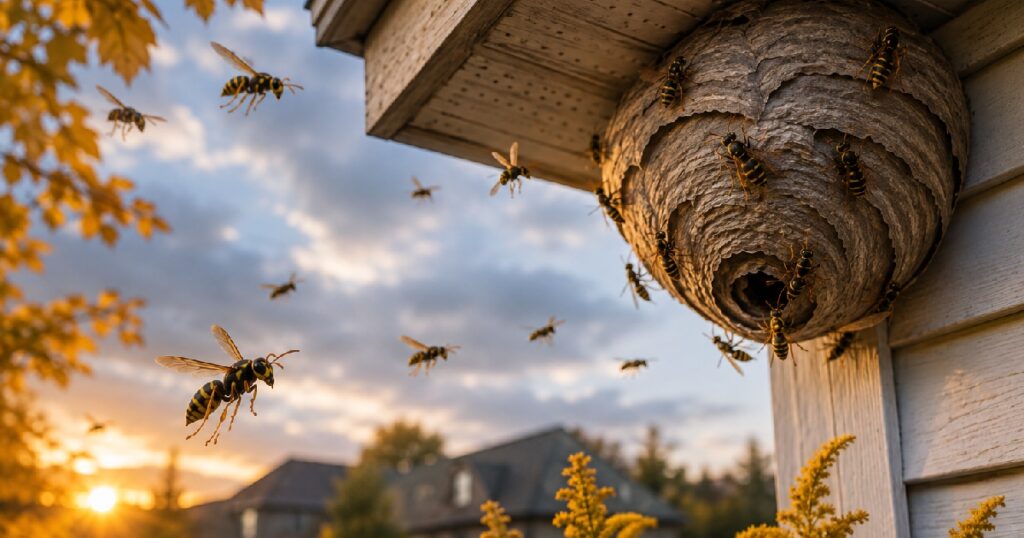
Edmonton’s wasp season doesn’t end in summer. The most aggressive weeks are actually late August through September, when colonies reach maximum size and workers turn desperate for sugar. This is when stings spike across the city, and it’s exactly when most homeowners realize they have a nest. Our guide to safe summer nest control covers the basics, but the late-season behavior below is different.
Key Takeaways
- → Edmonton’s wasp colonies hit peak size in late August and September, when worker populations can reach several thousand and food gets scarce.
- → Hungry worker wasps become aggressive around patios, garbage, and fruit trees, stings spike in September, not July.
- → Late-season nests are often hidden in ground holes, wall voids, and under decks, harder to spot, easier to disturb.
- → Professional removal is safest in peak season; sealing entry points now also blocks next spring’s queens.
Why Do Wasps Turn Aggressive in September?
Wasp colonies follow a strict calendar. In spring, a single queen starts a nest with a handful of workers. Through June and July the colony grows quietly. By late August, a mature Edmonton colony can hold several thousand workers, and that’s when the behavior changes.
The trigger is food. In summer, worker wasps feed on insects and nectar. By late August, insect populations drop and natural sugars run out. Workers become scavengers, hunting for anything sweet: soda, fruit, garbage, even BBQ drippings. The same wasps that ignored your patio in July now patrol it relentlessly.
There’s a second factor. In September, the colony stops raising new workers and starts producing new queens. The old workers have no purpose left except feeding the queens, and they defend the nest with everything they have. Aggression isn’t random. It’s biology. The same colony that ignored your deck all summer is now wired to defend its future queens, which is why a nest you walked past in July becomes a hazard in September.
What Time of Day Are Wasps Most Aggressive?
Wasps are most active and most aggressive during warm daylight hours, especially mid-afternoon when temperatures peak. In late summer Edmonton, that means roughly 1 PM to 6 PM, exactly when people are using patios, yards, and BBQs.
Early morning and evening are calmer, which is why professional removal happens at dusk. Cooler temperatures slow wasp metabolism, making them less reactive. If you spot a nest, don’t poke at it in the afternoon sun. That’s the worst possible timing.
One more detail worth knowing: wasps are territorial near the nest itself. A wasp foraging 20 meters away may ignore you completely. The same wasp a meter from its nest entrance will sting without hesitation. Distance from the nest matters more than anything else, so keep kids and pets away from any spot where you see a steady stream of wasps entering or leaving.
Where Do Late-Season Nests Hide?
Spring nests start small and visible, often hanging from eaves or porch ceilings. By September, many Edmonton nests have moved into protected cavities: ground holes, wall voids, under decks, inside sheds, or behind siding.
Ground nests are the most dangerous because they’re invisible until you step on them. Yellowjackets are the usual culprit, building golf-ball-size entrances in soil, mulch, or lawn edges. Mowing over one triggers a swarm response from hundreds of wasps in seconds, and yellowjackets will pursue a threat for dozens of meters before giving up.
Wall-void nests are a different problem. Wasps enter through a crack or vent and build inside the wall cavity. You’ll see wasps flying in and out of one spot, but the nest itself stays hidden. Disturbing these nests can push angry wasps into your living space.
Wasp Season Timeline in Edmonton
Knowing where you are on the wasp calendar tells you how careful to be. Here’s how the season breaks down in Edmonton:
| Season | Colony size | Aggression level | What to do |
|---|---|---|---|
| May to June | Small (dozens) | Low | Remove small nests early, seal gaps |
| July | Growing (hundreds) | Moderate | Keep garbage covered, watch eaves |
| August to September | Peak (thousands) | High | Call a professional, avoid nests |
| October | Declining | Drops after frost | Seal entry points for next spring |
The pattern is consistent every year. Edmonton’s freeze-thaw cycle creates fresh gaps in foundations and siding each spring, which is why sealing in the fall pays off twice: it stops this year’s stragglers and next year’s queens.
What Should You Do If Wasps Keep Circling Your Patio?
First, find the source. Watch where wasps fly, they travel in straight lines between food and the nest. A steady stream of wasps heading to one spot usually means the nest is nearby.
Next, remove attractants. Cover garbage bins, clean up fallen fruit, wipe down BBQ surfaces, and keep pet food indoors. Sugar sources in your yard are an open invitation during this hungry season.
Don’t swat. Swatting releases alarm pheromones that summon other wasps to defend. Don’t seal a nest entrance either, trapped wasps will chew through drywall to escape, and they’ll do it angry.
Is DIY Wasp Removal Safe in Peak Season?
Late-season nests are larger, better defended, and often hidden in cavities. Store-bought sprays kill the wasps they contact, but they rarely reach the core of a large nest, and they enrage every wasp they miss. Pest control operators in Alberta are licensed through Alberta Environment and Protected Areas and use pesticides regulated by the Government of Canada. A homeowner with a spray can has none of that training, and Health Canada’s sting safety guidance says the same thing: avoid disturbing nests and seek professional help for large ones.
Ground nests and wall voids should never be DIY projects because you cannot see the colony you’re disturbing, and a misjudged spray can turn a small problem into multiple stings. Professional treatment reaches the entire colony, removes the nest where needed, and follows up to confirm the wasps don’t rebuild. Our wasp removal service is built for exactly this. In Edmonton’s peak wasp weeks, that’s the difference between one call and a hospital visit.
What Happens to Wasps After September?
By late October, Edmonton’s first hard frost kills the colony. Workers die off, and only the newly produced queens survive, they find sheltered spots to overwinter and start new nests next spring. A nest that survives fall is a nest that produces hundreds of next year’s queens.
That’s why late-summer removal matters twice. Treating a nest now stops the current stings. Sealing entry points and removing nesting sites now also stops next spring’s queens from building in the same spots. One visit solves two seasons of problems.
Fall is also the best time to inspect your roofline, eaves, siding, and shed corners. Gaps you close in October are queens you never see in May.
Why Are Wasps Attracted to Your Edmonton Yard?
Wasps in late summer aren’t picky. They follow three things: sugar, protein, and shelter. Sugar comes from soda cans, juice spills, ripe fruit, and hummingbird feeders. Protein comes from uncovered garbage, pet food, and BBQ scraps. Shelter comes from eaves, sheds, woodpiles, and any cavity that stays dry.
A yard with all three is a wasp magnet in September. The fix is simple in theory and harder in practice: remove the attractants one by one. Cover bins with tight lids, pick up windfall fruit daily, wipe down outdoor tables, and rinse recycling before it goes out. Every source you remove sends some of those hungry workers elsewhere.
One thing people miss: standing water. Wasps drink, and late summer is dry in Edmonton. Birdbaths, pet bowls, and clogged gutters all draw them in. Tip out standing water or refresh it daily, and you shrink your yard’s appeal.
What Does a Wasp Sting Do to You?
A single wasp sting hurts, but for most people it’s a short-lived problem: sharp pain, redness, and swelling that settles within hours. The real risk is multiple stings, which can happen fast when a colony defends its nest. Dozens of stings in one incident can cause nausea, dizziness, and a serious reaction even in people without allergies.
For the roughly 2 percent of Canadians with insect venom allergy, one sting can trigger anaphylaxis: throat swelling, difficulty breathing, and a drop in blood pressure. That’s a 911 call, not a home remedy. If you or anyone in your household has a known bee or wasp allergy, never approach a nest yourself.
Wasps can also sting repeatedly because their stingers stay smooth. A bee stings once and dies; a wasp stings, withdraws, and stings again. A cornered wasp will hit the same person several times in seconds, which is why swatting or crushing one is such a bad idea and why the safest response to a wasp near you is to stay still and let it leave.
When Should You Call a Professional?
Call for same-day service if you find a nest near doors, windows, play areas, or high-traffic zones. Call immediately for ground nests or any nest inside a wall. And call if anyone in your household has a bee or wasp allergy, one sting can be life-threatening.
Edmonton Pest Control provides licensed, same-day wasp removal across the city. We also handle all other pest services for Edmonton homes and businesses. We treat the nest, remove it where safe, and follow up to confirm the colony is gone. Peak season is exactly when experience matters most, don’t test a large nest with a spray can.
Found a wasp nest? Same-day removal across Edmonton.