
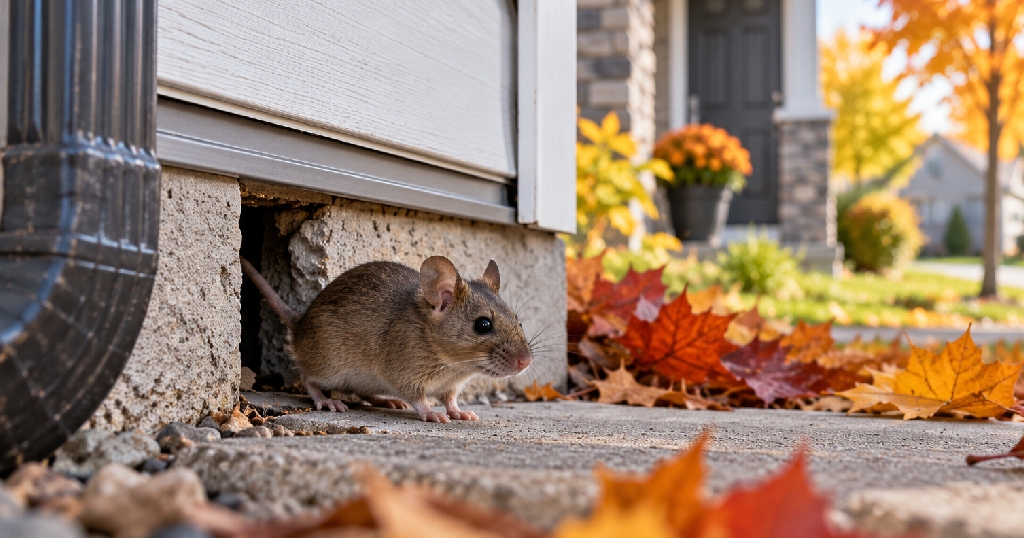
Every fall, Edmonton’s first frost sends house mice looking for warmth, and your home is exactly what they want. Rodents invade an estimated 21 million U.S. homes each winter (NPMA), and Alberta’s long cold season pushes them indoors by October. Here’s how to stop them before the first frost.
Key Takeaways
- → Fall is peak mouse season: central Alberta’s chance of a 0 C frost passes 95% by late September, pushing mice indoors (Alberta Climate Information Service).
- → A house mouse squeezes through cracks as small as a dime, so sealing means closing gaps most people never see (Health Canada).
- → An active mouse drops 50 to 75 pellets a day; droppings that return within five days of cleaning signal an active infestation (Nebraska Extension).
- → One female house mouse can raise 5 to 10 litters a year, so pros combine exclusion, removal, and sanitation (Nebraska Extension).
Why Do Mice Come Inside in Fall?
Mice move indoors in fall because cold weather strips away their outdoor food and shelter. Central Alberta’s chance of a 0 C frost climbs past 95% by late September (Alberta Climate Information Service). House mice don’t hibernate, so they follow the heat. That makes September and October peak mouse season in Edmonton.
In summer, mice nest in fields, gardens, and compost piles. When temperatures drop and vegetation dies back, they move toward garages, wall voids, basements, and kitchens. Once a mouse finds a route in, it rarely leaves, which is why prevention has to start before the first frost. In our fall service calls, most infestations trace back to a single gap that went unnoticed while the weather was warm.
What Are the Most Common Entry Points in Edmonton Homes?
Mice get in through surprisingly small openings. Health Canada notes that a house mouse can squeeze through a crack as small as a dime. It doesn’t need an open door, just a worn seal or a utility gap no wider than a pencil. Here are the six entry points we find most often.
| Entry Point | Why Mice Use It | How to Seal It |
|---|---|---|
| Garage and man-door gaps | Warped weatherstripping plus the gap under the door into the house. | Replace seals and add a door sweep. |
| Foundation cracks and sill plates | Settling cracks in concrete and the seam where foundation meets wood. | Fill with caulk plus steel wool or copper mesh. |
| Weep holes and brick veneer | Small openings at the base of brick on newer builds. | Insert mesh or a weep hole cover. |
| Utility penetrations | Unfinished gaps around gas, electrical, cable, and AC lines. | Seal with fire-rated caulk and metal mesh. |
| Vents and soffits | Dryer, bathroom exhaust, and eave vents with torn screens. | Cap with metal mesh or a vent cover. |
| Doors, windows, bulkheads | Worn weatherstripping and the hatch into an older basement. | Renew weatherstripping and seal the hatch. |
Walk the house exterior at dusk with a flashlight and check ground level first, since mice follow walls and pipes like highways. Basements need extra attention in winter: see our guide on keeping mice and voles out of your Edmonton basement.
How Can You Mouse-Proof Your Home Before Winter?
You’ll block most mice with one focused weekend of exclusion work. Sealing entry points is the most effective prevention step, and Health Canada lists rodent-proofing as the first line of defence against rats and mice. Work through this checklist before Edmonton’s first hard frost:
- Inspect at dusk: walk the foundation, garage, attic, and basement with a flashlight when mice are active.
- Seal every dime-sized gap: stuff openings with steel wool or copper mesh, then cover with caulk or foam. Mice gnaw through foam alone.
- Repair exterior doors: replace warped weatherstripping and install door sweeps so the bottom edge seals.
- Screen vents and weep holes: cap dryer, bathroom, and soffit vents with metal mesh.
- Fill utility penetrations: seal around pipes and wires with fire-rated caulk and metal mesh.
- Remove food and shelter: keep pantry goods, pet food, and birdseed in metal or glass, and clear wood piles from the foundation.
Prioritize the spots mice test first: the garage-to-house connection, basement windows, and attic soffits. We most often find missed gaps in utility and furnace rooms where pipes enter, so start there if you only have one weekend. For a complete room-by-room plan, see our ultimate guide to rodent-proofing your Edmonton home for the Alberta winter.
Not sure where mice are getting in? A local inspection finds the gaps you can’t see.
What Are the Early Signs of a Mouse Problem in Your Edmonton Home?
Mice leave evidence long before you see one. An active mouse drops 50 to 75 pellets a day, so check along baseboards, behind appliances, and in pantry corners (Nebraska Extension). Here’s what our technicians look for:
- Droppings: dark, rice-grain-sized pellets with pointed ends, scattered along walls and in drawers.
- Gnaw marks: fresh chew marks on wood and food packaging, often with fine shavings underneath.
- Rub marks: greasy grey smudges along baseboards where mice brush past.
- Scratching at night: rustling inside walls, ceilings, and under floors when the house is quiet.
- Nests: shredded paper, insulation, and fabric stuffed into drawers or attic corners.
- Pet behaviour: a dog or cat fixated on a wall often hears mice before you do.
Use the five-day test to separate old activity from an active infestation. Wipe up all droppings and mark the date. If fresh, dark, moist droppings reappear within five days, you’ve got mice living there; old droppings turn grey and crumbly. For help telling mice from larger rodents, see our rats vs. mice guide.
Clean droppings safely: never sweep or vacuum them dry, since that stirs contaminated dust into the air. Alberta Health Services warns dried rodent droppings can carry hantavirus, with 16 cases confirmed in Alberta between 2014 and 2018. Wet the area, wear gloves, and disinfect before removal. Deer mice, the main carriers, are most common near Edmonton’s river valleys; our article on hantavirus and rodent control explains the wider risk.
When Does DIY Mouse Control Stop Working?
Traps handle one or two mice, but they lose to a breeding pair. A female house mouse can raise 5 to 10 litters of 5 to 6 young per year (Nebraska Extension). Fresh droppings after two weeks of trapping and sealing usually mean a nest, not a lone wanderer. Here’s how the two approaches compare:
| Approach | Works Best When | Call a Pro When |
|---|---|---|
| Sealing and exclusion | You find gaps before mice find them. | A missed gap keeps letting mice in. |
| Traps | One or two mice, early signs only. | Fresh droppings last more than two weeks. |
| Registered baits | Only alongside sealing and sanitation (Health Canada). | Kids or pets make bait placement risky. |
| Professional treatment | Activity continues despite your best DIY effort. | Scratching in walls or signs in several rooms. |
DIY also has safety limits. Health Canada requires a Pest Control Products number on registered pesticides and warns against using baits as the only control method. Ultrasonic devices rarely work alone because mice adapt, and poisons need to stay away from children and pets. Exclusion is physical work, too: ladders, crawl spaces, attics. One missed gap lets the problem continue, and that’s the signal to call someone who does this daily.
When Should You Call an Exterminator?
Call an Edmonton exterminator when mouse activity continues after two weeks of sealing and trapping. Hear scratching in walls? Call right away. Established colonies hide in wall voids where DIY traps can’t reach.
A licensed technician does three things DIY can’t: a full exterior-to-interior inspection, targeted removal matched to mouse behaviour, and sanitation guidance. Certified applicators also know which Health Canada-registered products are safe around children and pets.
One exception: if you spot a much larger rodent or an outdoor burrow, report it. Edmonton sits inside Alberta’s rat control program, and the City of Edmonton asks residents to call 311 with rat sightings. House mice are a homeowner problem, best left to a licensed pest professional.
Mice are predictable: they move in with the cold and follow the same gaps every fall. Seal those gaps now, watch for early signs, and act fast. Prevention beats months of scratching inside your walls.
Call (587) 568-9403 or Get Your Free Quote