
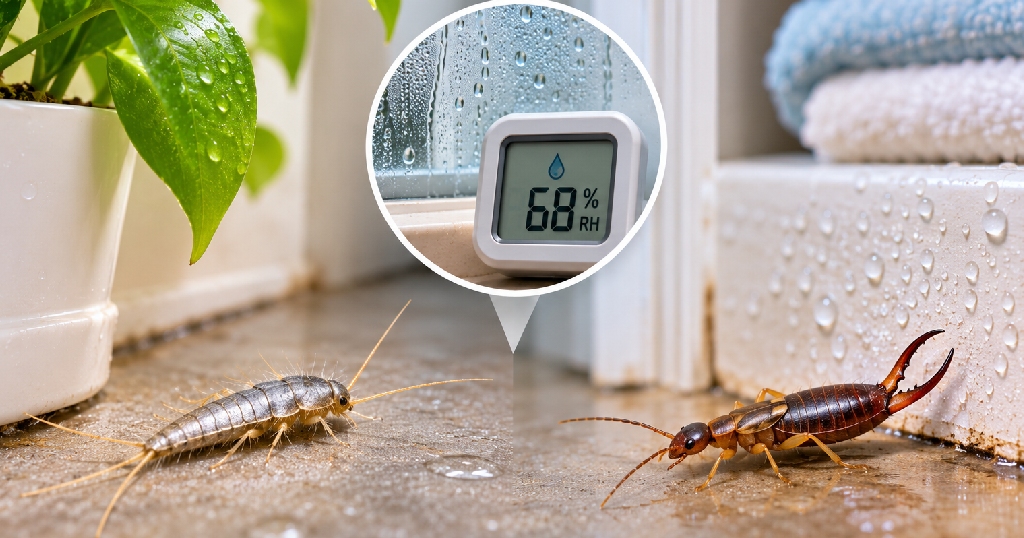
A silverfish flickers across the bathroom tile at midnight, or a crowd of earwigs spills out from under a wet doormat after a rainstorm. Both pests follow moisture into Edmonton homes, and both look far worse than they are. Here is what pulls them inside and how to shut the water and shelter off.
Key Takeaways
- → Silverfish prefer 75 to 95% relative humidity, so bathrooms, basements and laundry rooms carry the highest risk (Health Canada).
- → Silverfish are harmless to people but scrape starch, glue and paper, and a large indoor population means a longstanding damp problem (Health Canada).
- → Earwigs are accidental invaders, not indoor breeders, and usually start wandering into homes in June or July (Health Canada).
- → Drying the air and clearing damp debris near the foundation removes what both pests need, so moisture control comes before spraying.
Why Do Silverfish and Earwigs Turn Up in Edmonton Homes?
Moisture is the invitation. Silverfish settle where relative humidity holds between 75 and 95%, typically sinks, bathtubs and plumbing fixtures where they crawl for water and sometimes fall in and cannot climb out (Health Canada). Edmonton basements, humid laundry rooms and poorly vented bathrooms hold that microclimate from October through April, while the furnace runs and windows stay shut.
Heat does not cancel the risk. UC IPM reports silverfish favour 71 to 90°F, and at the higher end humidity has to stay above 75% (UC IPM). The firebrat, their close relative, prefers hot dry spots near furnaces and water heaters (Health Canada). Both travel along pipes from the basement up, so sightings often start below grade and surface upstairs.
Earwigs come from outside. They shelter in cool, dark, moist spots by day and forage at dusk, climbing foundations and slipping through door gaps (Health Canada). Wet mulch, leaf litter and woodpiles against the wall give them a staging ground. Cluster flies and boxelder bugs in Edmonton use the same fall route through foundation gaps.
How Do You Tell Silverfish Apart from Earwigs?
Size and shape settle it in seconds. Adult silverfish run just over 1 cm with two long antennae and three bristle-like tails, giving them the nickname bristletails, while adult earwigs reach 1.5 to 2 cm and carry visible pincers (Health Canada). The table below lines up the differences that matter for treatment.
| Feature | Silverfish | Earwigs |
|---|---|---|
| Look | Silver scales, carrot shape, three tail bristles | Reddish brown, flat, forceps at the rear |
| Length | Just over 1 cm | 1.5 to 2 cm |
| Indoor hot spots | Bathrooms, basements, wall voids, bookcases | Entry mats, door frames, potted plants, damp cracks |
| Diet | Starch, glue, paper, wallpaper paste, dead insects | Decaying plants, soft-bodied insects, tender shoots |
| Risk to people | None: no bite, no disease, only property damage | A startled pinch at most, otherwise harmless |
| Breeds indoors | Yes, slowly, over years | No, nests stay in garden soil |
Earwigs are often beneficial outdoors, hunting aphids and slug eggs (Health Canada). Silverfish earn no such credit: weak jaws scrape rather than bite, leaving irregular chewed patches on paper, wallpaper and starched fabric (UC IPM). If an insect is unfamiliar, the City of Edmonton identifies insects for residents.
Why Does a Silverfish in the House Always Point to Moisture?
Because the insect cannot survive without it. Silverfish live for many months without food, yet they still need damp air, which is why a large indoor infestation signals a longstanding humidity problem rather than a recent invasion (Health Canada). Alberta Health Services lists silverfish among the pests common in Alberta and names warm, damp, poorly ventilated areas as the conditions that let them settle in (Alberta Health Services).
The life cycle explains the patience. Silverfish keep molting after they reach adulthood, passing through roughly 45 to 60 instars across a lifespan of about three years (UC IPM). Texas A&M Extension puts the count at up to 60 molts over a two to three year life (Texas A&M AgriLife Extension). Each molt leaves a shed skin, so scattered silver casings in a tub or along a closet shelf are direct evidence of an established colony.
Yellow staining on wallpaper, scraped page edges, and a silverfish darting out when a box moves all point to the same source: a wall, a subfloor or a plumbing chase holding moisture. Fixing that does more than any aerosol.
Finding silverfish in the same bathroom every week? A moisture inspection traces the leak, the venting gap or the damp crawlspace feeding them.
How Earwig Infestations Build in Edmonton Yards
The nest starts in soil, not in the house. A female European earwig lays a cluster of 50 to 90 eggs in a chamber underground in fall, then guards them through winter and feeds the first nymphs in spring (Wisconsin Horticulture). Penn State Extension notes the species produces one generation per year, with heavy maternal care for eggs and early nymphs (Penn State Extension). Cold is not a barrier, since they dig deep into soil to escape it.
By July those nymphs are adults, and dry weather sends them hunting moisture. Anything holding damp shade near your wall becomes shelter: bags of soil, plant saucers, a woodpile. Health Canada’s controls target that weak point in early spring, when the young are vulnerable. Cultivate soil to expose overwintered earwigs and eggs, pull mulch back from the foundation, and repair leaky taps and downspouts (Health Canada).
Traps do the rest without chemicals. Roll damp corrugated cardboard into a tube, or invert a flower pot stuffed with moist straw, and set it where earwigs gather. Check daily and knock the contents into a pail of soapy water. The carpenter ants in Edmonton guide covers the damp wood these shelters often hide.
How Do You Get Rid of Silverfish and Earwigs for Good?
Dry the building, remove the shelter, then treat what remains. Start with ventilation and leaks, because silverfish respond to humidity before any product. Run the bathroom fan during and after showers, fix dripping supply lines under sinks, dry a damp basement with a dehumidifier, and keep paper, cardboard and starch-heavy fabric in sealed bins rather than open shelves.
Sealing and cleaning follow. Caulk the gap between baseboards and floor, close pipe penetrations, vacuum cracks and closet corners, and keep cardboard away from exterior walls. Health Canada calls cleaning the most important part of silverfish control, and a jar trap confirms whether activity has stopped: wrap the outside of a glass jar with tape, set it near the sink, and silverfish climb the rough surface but cannot climb out of the smooth glass (Health Canada).
Outside, cut the habitat. Trim vegetation away from siding, move woodpiles and compost off the wall, clear leaves from window wells, and check garden produce before carrying it in. If you use a pesticide, look for a Pest Control Products number on the label, which confirms Health Canada approval for that use (Health Canada). Homes with pets deserve a look at flea and tick control for Edmonton homes and pets before any broadcast treatment.
When Prevention Fails: What a Professional Inspection Finds
Some reservoirs sit out of reach. A silverfish population that survives a dry basement usually has a wall void, subfloor cavity, crawlspace or shared plumbing chase feeding it, and those spaces stay humid no matter how often the bathroom is wiped down. Earwigs look just as persistent when a neighbour’s mulch bed keeps producing them.
An inspection maps the moisture and entry points instead of guessing. A licensed applicator checks the rim joist, crawlspace vapour barrier, window wells and the gap behind siding, then treats harbourage areas and sets a recheck date. That approach follows integrated pest management, which the City of Edmonton applies to its own pest programs (City of Edmonton). Closing entry gaps also blocks rodents, and our rodent-proofing guide for the Alberta winter walks through that sealing step by step.
One number is worth remembering: silverfish hold on at 75 to 95% humidity (Health Canada). Get the air below that and the colony loses its foothold without a single spray.
Call (587) 568-9403 or Book a Silverfish and Earwig Inspection