
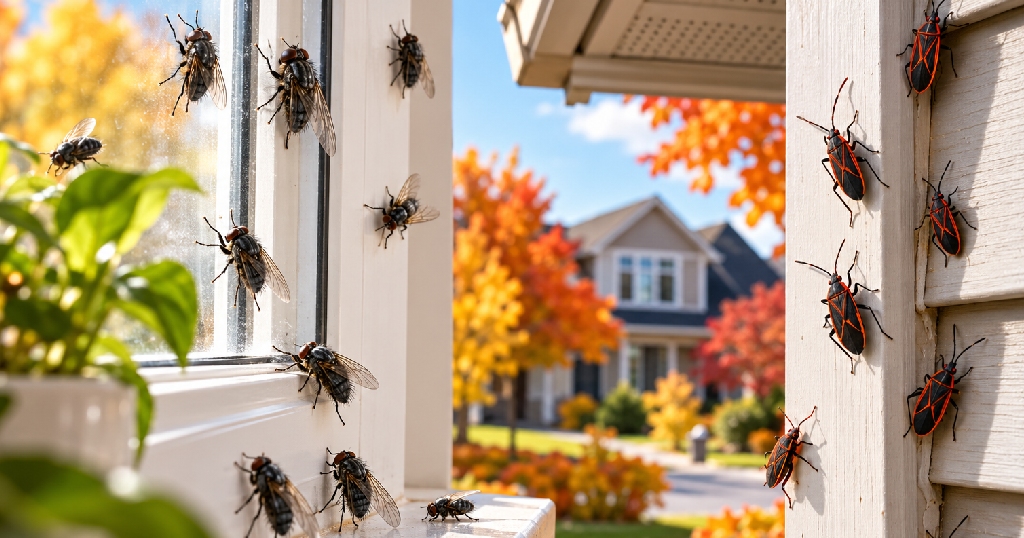
Sluggish flies clustering on your sunniest window and black and orange bugs massing on your siding mean fall has arrived in Edmonton. Cluster flies and boxelder bugs both invade homes this time of year, and they want the same thing: a warm place to wait out the Alberta winter (Health Canada). This guide explains why they show up, how to tell them apart, and how to shut them out.
Key Takeaways
- → Cluster flies and boxelder bugs both come indoors in fall for shelter, not food, and neither breeds once inside (Health Canada).
- → Neither insect bites, stings, or spreads disease, but both can stain walls and release an odour when crushed (NPIC).
- → Boxelder bugs can fly up to two miles to reach a warm wall, so removing one tree rarely ends the problem (NPIC).
- → Sealing cracks before the cold sets in is the most effective step, because sprays and traps only catch what is already indoors (Penn State Extension).
Why Do Cluster Flies and Boxelder Bugs Invade Edmonton Homes in Fall?
Both invaders come inside for shelter, not food. Cluster flies begin hunting for a winter site when the days shorten in late summer and early fall, and they’re drawn to the warm south and west sides of buildings (Health Canada). Boxelder bugs follow the same pattern, gathering on sunny walls and fences as temperatures drop (City of Calgary).
That sets them apart from ants or mice. These bugs aren’t chasing crumbs or nesting material. They want a cool, protected void to sleep through the cold. A gap the width of a fingernail is enough. Cluster flies hibernate in wall voids, attics, closets, and empty rooms (Health Canada). Boxelder bugs slip through soffit and dryer vents, gaps along siding, and unscreened windows (NPIC).
Here’s the part that catches homeowners off guard. On warm winter days, both pests wake up and move toward the light. You may spot flies buzzing at a window or bugs crawling across a ceiling in January, months after they slipped in.
In our fall service calls, that mid-winter swarm is often the first clue a wall void has held insects since September. To see how the pest calendar shifts month by month here, our guide to Edmonton pest control trends for 2026 is a useful reference.
What Do Cluster Flies and Boxelder Bugs Look Like?
The two are easy to separate once you know what to check. Cluster flies run 8 to 10 mm long, with dark grey bodies, black and silver checkered abdomens, and fine golden hairs on the thorax (Health Canada). Boxelder bugs are slightly larger at about 12 mm, with black bodies, red eyes, and reddish-orange veins across the wings (City of Calgary). Both look harmless, but only one carries the golden sheen.
| Feature | Cluster Flies | Boxelder Bugs |
|---|---|---|
| Size | 8 to 10 mm, a little bigger than a house fly | Around 12 mm, flatter and wider |
| Colour | Dull grey with black and silver checkering | Black with red-orange wing veins |
| Where you see them | Attics, wall voids, upper windows | Sunny south and west walls, siding, soffits |
| Peak season | Late summer through fall | Late summer through fall |
| Bite or sting? | No | No |
| Breed indoors? | No | No |
Don’t reach for a swatter. Cluster flies can leave small dark stains and a sickly sweet odour when crushed, and boxelder bugs release an unpleasant smell of their own (NPIC). Vacuum them instead, then empty the bag outdoors right away. Crushing them turns a small problem into a stained wall.
Confusing a cluster fly with a common house fly changes what you do. House flies breed in garbage and can spread food-borne illness, but cluster flies don’t reproduce indoors and don’t feed once inside (Health Canada). A sluggish fly with a golden sheen and overlapping wings is a cluster fly, a nuisance rather than a sanitation problem.
Are Cluster Flies and Boxelder Bugs Harmful?
Neither insect bites or stings, and neither is known to transmit disease to people (NPIC). Cluster flies feed outdoors and develop as parasites of earthworms, so they don’t carry the filth that house flies do (Health Canada). Boxelder bugs feed on Manitoba maple trees and cause no structural damage to a home (City of Calgary).
So the risk is annoyance, not illness. Cluster flies leave small spots of excrement on windows and walls over time (Penn State Extension). Boxelder bugs stain light surfaces. There’s one knock-on problem worth knowing. When cluster flies die inside a wall void, their bodies can attract larder beetles, which then feed on them and move on to stored woolens and dry goods (Health Canada).
If you’ve got a health question about a pest inside your home, Alberta Health Services publishes free guidance for homeowners through its Environmental Public Health home and family resources. For most Edmonton households, though, these two are a cleanup job, not a medical one.
Seeing swarms at your windows? A fall inspection finds the entry points before winter locks them in.
How Do You Keep Fall Invaders Out of Your Edmonton Home?
Exclusion does more than any spray. Seal cracks around windows, doors, siding, utility pipes, and under the fascia with silicone or silicone-latex caulk, and repair or replace damaged screens (Penn State Extension). Do the work in late summer, because boxelder bugs begin moving toward buildings as soon as the nights cool (City of Calgary).
Then strip out the shelter they like. Rake up leaf piles, move wood stacks away from the walls, and clear rock piles and debris near the foundation (NPIC). Trim branches that touch the house. Boxelder bugs can fly up to two miles to reach a warm wall, so a single tree removal rarely helps (NPIC). The City of Edmonton offers a free insect identification service if you’re unsure what you’ve caught.
Screen the openings you can’t seal. Fit insect mesh over soffit and air vents, add door sweeps on exterior doors, and check dryer vents and outdoor faucets, which are common boxelder bug entry points (NPIC).
These are the same gaps that let wildlife and wood-destroying pests inside. Our rodent-proofing guide for the Alberta winter walks through the sealing work step by step, and our post on carpenter ants in Edmonton explains why hidden voids matter.
If a few have already slipped inside, vacuum them and empty the bag outdoors. Window traps can catch cluster flies, and some contain a powder that works like quicksand (Health Canada). Be cautious with outdoor sprays. Insecticide residue breaks down in sunlight and may stop killing flies within a few days to a week, so timing matters far more than volume (Penn State Extension).
When to Call a Professional for Fall Insect Control in Edmonton
Bring in a licensed professional when invaders keep getting in after you’ve sealed the obvious gaps, when you find them in several rooms, or when a wall void or attic is holding thousands of flies (Penn State Extension). A pro can pinpoint entry points you’d never find and time a perimeter treatment to the autumn congregation window (City of Calgary).
DIY sprays fall short for a simple reason. Cluster flies that have already reached a wall void are hard to reach, and treating those spaces with insecticide dust can set off the larder beetle problem described earlier (Penn State Extension). It’s better to stop them at the wall than to chase them through the house.
Fall work is also the moment to look at the whole property. If wasps are still active on your eaves, our guide to why wasps get aggressive in late summer covers safe nest handling before you tackle the other intruders.
Stop Fall Invaders Before the First Frost
Cluster flies and boxelder bugs are a fall problem with a simple fix. Seal the gaps before the cold sets in, clear the debris that shelters them, and vacuum the ones that slip through. Neither pest breeds or bites indoors, so the goal is keeping them out, not chasing them once they are in (Health Canada).
If you’re still seeing swarms at the windows when the snow flies, the entry points are hidden. A professional inspection finds them, seals them, and treats the sun-facing walls before next fall’s invasion begins.
Call (587) 568-9403 or Get Fall Pest Help