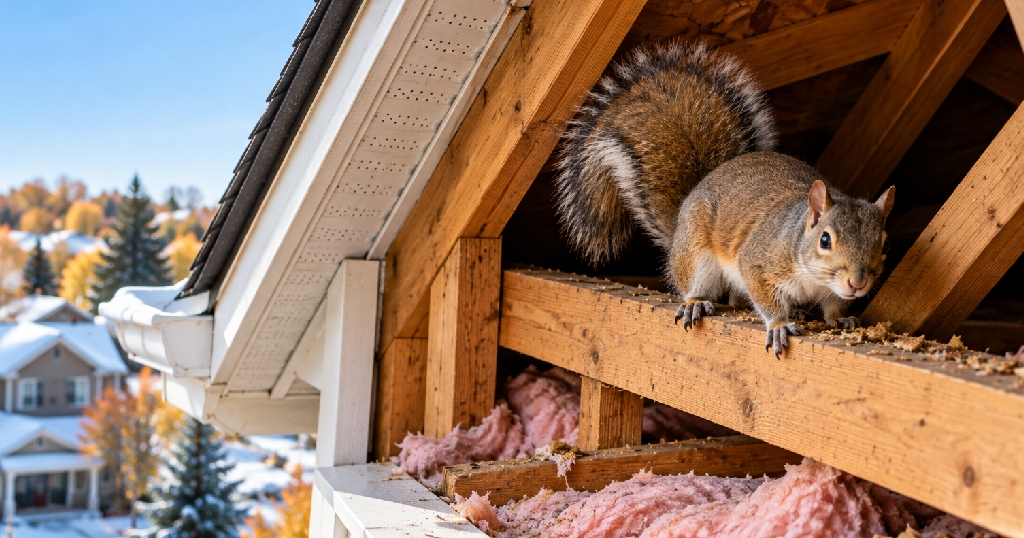
If you hear scratching above your bedroom in the early morning, a squirrel is likely living in your attic. Red squirrels and northern flying squirrels both den in Edmonton homes as temperatures drop, and they chew through wiring, insulation, and roof decking to get in. This guide covers the signs, the damage they cause, Alberta’s rules on trapping, and how to get them out before winter.
Key Takeaways
- → Squirrels enter Edmonton attics in fall because attics stay warm and dry through winter. The first hard frost, usually mid-October, triggers the move.
- → Chewed wiring is the highest-risk outcome. Rodent damage is excluded from many Canadian home insurance policies, so check yours before assuming cover.
- → Trapping on your own property is legal in Alberta, but a live-trapped squirrel must be released at least 15 km away ([Alberta Wildlife Act](https://www.alberta.ca/wildlife-act), Alberta.ca).
- → Sealing the entry point matters more than catching the animal. Trapping without exclusion usually means a second squirrel within weeks.
Why Do Squirrels Move Into Edmonton Attics in Fall?
Squirrels move into Edmonton attics in fall because attics are warm, dry, and rarely disturbed. A female squirrel seeking a winter den finds a roof cavity easier to occupy than building a nest from scratch. Research on North American red squirrels shows they defend a single territory and cache food within it (University of Alberta, 2024). That territory is often a residential lot. An attic sits directly above it.
Cold snaps trigger the move. The first hard frost in Edmonton usually lands in mid-October. Once overnight temperatures drop below freezing, a squirrel that spent summer in a tree hollow starts looking for better insulation.
Attics win on three counts. They hold heat from the house below. They stay dry through freeze-thaw cycles. And they have almost no predators. A squirrel that finds a gap in your soffit has found a den site it will defend.
The timing matters for homeowners. Squirrels are most active on roofs in September and October, which is exactly when most people stop looking upward. By the time scratching becomes audible in January, the animal has been in place for months.
What Are the Signs of Squirrels in the Attic?
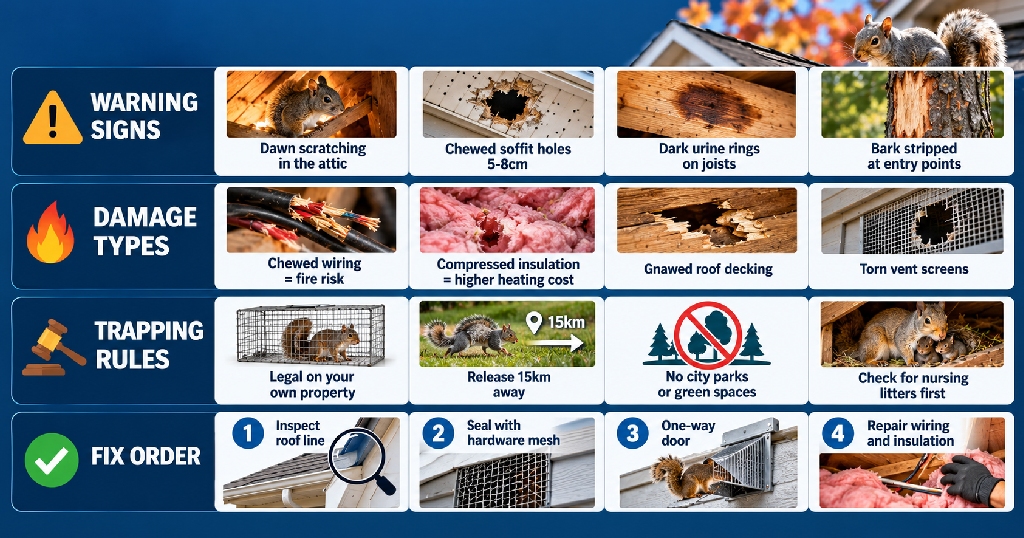
The clearest sign of squirrels in an attic is scratching and scurrying sounds in the early morning, roughly one hour before sunrise. Squirrels are diurnal, so they wake and move before most homeowners do. This timing separates them from mice and rats, which are active mostly after dark.
Listen for the pattern. A squirrel’s movement is a heavy, uneven scurry with pauses. Mice produce rapid light patter. Raccoons sound larger and slower, often with a thump. If the noise stops when you knock on the ceiling, you are dealing with a mammal, not a bird.
Look for physical evidence outside. Check the roof line and soffits for chewed openings roughly 5 to 8 centimetres across. Squirrels rarely use an existing hole. They enlarge gaps and gnaw new ones. Look for stripped bark near the entry point and droppings on the roof surface.
Inside, check the attic for three things. Nested shredded insulation or paper, which squirrels shape into a ball. Urine staining on ceiling joists, which appears as dark rings. And chewed wire insulation, which is the most serious finding of the three.
One more signal: a squirrel will often sit on your roof or a nearby branch and scold anything that approaches. If you have a squirrel that barks at you from the same spot every morning, it likely has a den nearby.
What Damage Do Squirrels Cause in Edmonton Homes?
Squirrels cause structural and electrical damage that often goes unnoticed until a problem surfaces. A rodent’s front teeth grow continuously, so they gnaw to wear them down. Electrical cable insulation is a convenient target.
Chewed wiring is the highest-risk outcome. Squirrels strip the outer sheath and the conductor insulation beneath it, exposing copper. Arcing from damaged conductors is a recognised cause of attic fires (National Fire Protection Association, 2024). Not all home policies cover rodent damage, so check yours before assuming you are protected.
Insulation damage is the second cost. A squirrel den compresses and contaminates loose-fill insulation. Compressed insulation loses R-value, which raises heating costs through an Edmonton winter. Squirrels also tunnel through insulation, creating channels that let warm air escape.
Structural damage accumulates more slowly. Squirrels gnaw roof decking, fascia, and occasionally structural members. They also chew through ventilation screens, which allows moisture into the roof assembly. In an Edmonton freeze-thaw climate, moisture in the roof cavity leads to ice damming and rot.
The odour problem is real but secondary. Squirrel urine and droppings leave a persistent smell that can reach living areas through ceiling gaps. Removing the animal does not remove the smell. Contaminated insulation usually needs replacement.
Is It Legal to Trap Squirrels in Alberta?
Trapping a squirrel on your own property is legal in Alberta, but relocating it is not straightforward. Alberta’s Wildlife Act classifies squirrels as fur-bearing animals with specific handling rules. You cannot simply catch one and release it in a park.
The relocation rule catches most homeowners off guard. Under Alberta regulations, a live-trapped squirrel must be released at least 15 kilometres from where it was caught, and the release must be on land where you have permission or on Crown land where discharge of a firearm is permitted (Alberta.ca). Releasing a squirrel in a city park or green space is not a legal option.
Timing adds a second constraint. Squirrels typically produce two litters per year, one in spring and one in late summer. A trapped female may be nursing. Trapping and relocating a nursing mother separates her from dependent young, which then die in the attic and create a worse odour and insect problem than the original squirrel.
There is also the exclusion-first principle. Trapping removes the animal currently inside. It does nothing about the entry hole. In most cases a second squirrel occupies the same attic within weeks. Effective removal means sealing the structure, not just catching one animal.
For these reasons, most Edmonton homeowners reach a professional far faster than they expect. The trap is the easy part. The legal release location, the litter question, and the permanent exclusion work are what turn it into a job.
How Do You Get Squirrels Out of an Edmonton Attic?
Getting squirrels out involves four steps in order: inspection, exclusion, removal of the animal, and repair. Doing them out of order usually means repeating the job.
Inspection comes first. Walk the full exterior at roof level. Squirrels use soffit gaps, roof-to-wall junctions, vents, and chimney flashing. A hole you cannot see from the ground is the one that matters. Look for grease marks, which squirrels leave as they squeeze through the same gap repeatedly.
Exclusion is the step that prevents recurrence. Seal every opening with hardware cloth or galvanized steel mesh, not expanding foam. Squirrels chew through foam in days. Mesh must be fastened and, where animals will push against it, backed with a solid surface. Underground or low-access entries need buried mesh extending outward, because squirrels will dig at the base of a barrier.
Removal means excluding the animal from inside before you seal the last opening. A one-way door lets the squirrel leave and prevents re-entry. This must be installed on the primary entry point and left in place long enough for the animal to exit and stop trying to return. Sealing an attic with a squirrel still inside traps it and creates a decomposition problem within days.
Repair covers the damage left behind. Replace chewed wiring, which requires an electrician. Remove and replace contaminated insulation. Treat the affected area for odour. Repair the roof decking and ventilation where gnawing occurred.
Timing matters for the schedule. The best window is late fall, after summer litters have dispersed and before deep winter. Squirrels are less likely to be nursing, and the animal is actively looking for a den, which makes the one-way door more effective.
How Do You Stop Squirrels From Coming Back?
Prevention works when it removes both the access and the attraction. Sealing alone is not enough if the property still offers food and shelter.
Start with tree branches. Squirrels reach roofs by jumping from overhanging limbs. Any branch within roughly 3 metres of the roofline is a bridge. Trimming those back is the single most effective exclusion step, and it is the one homeowners most often skip. Extension guidance on wildlife-proofing a home recommends a 2 to 3 metre clearance as standard (Iowa State University Extension, 2024).
Move food sources. Bird feeders are squirrel magnets. If you keep feeders, use baffles and place them well away from the house. Secure garbage bins with locking lids. Clean up fallen fruit from trees before it ferments.
Maintain the exterior. Repair loose fascia, replace damaged soffit screens, and check vents seasonally. Squirrels remember a gap and return to it. A gap that stayed open through summer will be used again in October.
Consider deterrents as a supplement, not a solution. Motion-activated lights and ultrasonic devices have limited and inconsistent effect on squirrels, which habituate quickly. They are not a substitute for physical exclusion.
Get an inspection before winter. Fall is the season when entry attempts happen. An inspection in September or October catches a fresh gap before it becomes a den.
When Should You Call a Professional for Squirrel Removal in Edmonton?
Call a professional when the animal is inside the structure, when there may be young present, or when the damage reaches wiring or insulation. Those three conditions cover most real cases.
If a squirrel is merely on your roof or in a tree, you have time. Monitor and trim branches. If you hear it in the attic, the situation has changed. A squirrel that has entered once will enter again, and the entry point needs to be found and sealed, which usually means getting onto the roof.
Nursing litters are the most common reason a DIY attempt fails. A homeowner traps an adult, seals the hole, and two weeks later has an odour problem and a fly infestation. A professional inspects for young before sealing, and handles removal in the correct sequence.
Wiring damage is the reason not to delay. If you find chewed cables in the attic, stop using the circuit if you can identify it, and bring in an electrician alongside the wildlife work. This is not a pest problem at that point. It is a fire-safety problem.
Coverage area matters too. Not every Edmonton pest company handles wildlife. Squirrels fall under wildlife removal rather than general pest control, and the licensing and equipment are different.
Stop the Scratching Before the Cold Sets In
Squirrels in an Edmonton attic are a fall problem that becomes a winter expense. The animal moves in during September and October. The chewed wiring and compressed insulation are discovered later, usually after a cold snap.
You can confirm the situation yourself. Listen at dawn for a heavy scurry above the ceiling. Check your soffits and roof line for fresh gnaw marks. Trim any branch within 3 metres of the roof. Those three steps tell you whether you have a squirrel and whether it has a way in.
What you cannot easily do yourself is the legal release, the litter check, and the permanent exclusion work. Trapping one animal without sealing the structure just resets the clock.
If you have heard scratching above your ceiling, see our guide to when to call a professional exterminator in Edmonton, review our residential pest control services, or read about why fall is the peak season for rodent entry. Our team handles wildlife removal and exclusion across Edmonton, and we inspect for entry points before we close anything.