Edmonton’s Wasp Season Is Nothing to Take Lightly
One minute you’re barbecuing in the backyard, the next you’re swatting away yellowjackets that seem to multiply by the dozen. Edmonton’s wasp and bee season runs roughly from May through September, but August is when things get serious. A mature yellowjacket colony can grow to 4,000–5,000 workers, and these insects don’t hesitate to defend their territory aggressively.
The city of Edmonton’s own pest management teams removed 374 wasp nests in a single summer — up from just 121 the year before. That’s a threefold increase, and it signals something homeowners can’t ignore: the wasp population is growing, and knowing when to tackle the problem yourself versus calling in a professional can mean the difference between a quick fix and a trip to the emergency room.
This guide covers everything you need to know about wasp removal Edmonton homeowners face every year — from identifying the threat to making the right call.
Bees vs. Wasps: Know Who You’re Dealing With
It sounds simple, but misidentifying the insect in your yard is the first mistake many Edmonton homeowners make. Bees and wasps look similar at a glance, but they require completely different approaches.
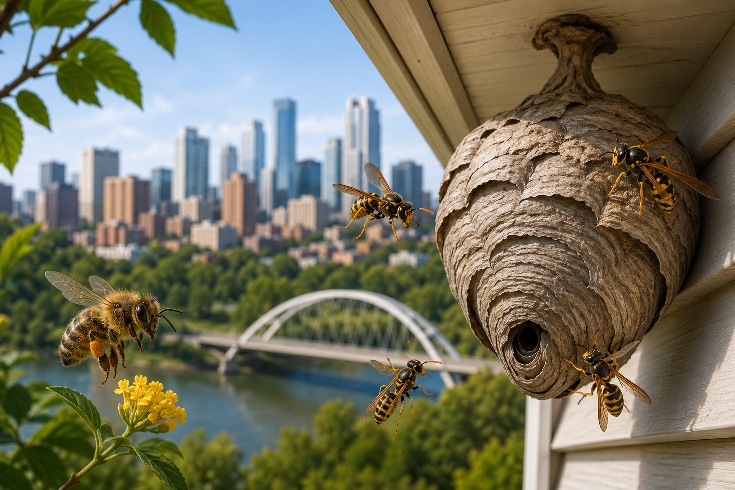
Bees are fuzzy, round-bodied, and focused on pollination. They carry pollen on their hind legs, visit flowers, and usually sting only once before dying. Alberta’s Native Bee Council recommends using a beekeeper for honeybee nest removal in structures. Wasps, on the other hand, have smooth, narrow-waisted bodies, hunt other insects aggressively, and can sting repeatedly. They’re drawn to food at barbecues, garbage cans, and sweet drinks — classic Edmonton patio problems.
Here’s a quick comparison:
- Bees: Fuzzy bodies, single sting, build wax honeycomb hives, important pollinators
- Wasps: Smooth, narrow waist, multiple stings, build papery nests (ground, wall voids, eaves), active hunters
- Yellowjackets (Edmonton’s main concern): Aggressive, attracted to human food, colony peaks at 4,000–5,000 in late summer
Location is a clue too. If insects are on flowers, you’re probably looking at bees. If they’re coming from a papery nest under your deck or in a wall hole, those are wasps. Mixing up the two means using the wrong removal method — and possibly harming protected pollinators.
| Feature | Honeybees | Wasps / Yellowjackets |
|---|---|---|
| Body | Fuzzy, robust | Smooth, slender |
| Sting | Once (dies after) | Multiple times |
| Nest | Wax honeycomb | Papery / mud |
| Attracted to | Flowers, pollen | Meat, sweets, garbage |
| Aggression | Low (defensive only) | High (territorial) |
| Removal | Beekeeper relocation | Pest control professional |
When to Call a Professional (Skip DIY)
Don’t reach for the spray can if any of these apply. Calling a professional isn’t wasted money — it’s insurance against a serious sting incident, and it’s often cheaper than an emergency room visit.
Nest in a wall void, attic, or soffit: These locations mean you’re dealing with wasps inside your home’s structure. Disturbing a nest inside a wall can send hundreds of wasps into your living space. Professional pest controllers have access to commercial-grade products and know how to seal entry points before treatment.
Nest near entryways or high-traffic areas: If the nest is near your front door, kids’ play equipment, or a patio you use daily, professional removal is the only sensible option. A disturbed nest can trigger mass attacks — yellowjackets release a pheromone that recruits every nearby wasp in seconds.
Large nests: If you’re seeing more than a handful of wasps at any given time, assume the colony is already substantial. Larger colonies mean more defensive wasps and a higher chance of multiple stings.
Allergy concerns: If anyone in your household has a known sting allergy — or even if you’re not sure — call a professional. Anaphylaxis can develop rapidly, even in people who’ve been stung before without issue. This isn’t worth testing.
After-hours or same-day emergencies with kids around: Professional Edmonton pest control services offer emergency response, often with same-day availability during peak season. The premium for urgency is nothing compared to the risk.
Other red flags: nests underground, in roof spaces, near electrical fixtures, or anywhere requiring a ladder. Falls from ladders account for a significant number of DIY wasp removal injuries too — it’s not just the stings.
What DIY Removal Actually Looks Like
Let’s be honest about what DIY wasp removal involves. You’re spending $30–$50 on insecticide spray, dressing up in whatever you can find to cover your skin, and approaching a nest full of thousands of insects that can sting you repeatedly. You have one shot — get too close to the wrong nest at the wrong time and you’re in trouble.
Here are the conditions when DIY is technically possible:
- Small, exposed nest in an accessible location (e.g., under a deck you can walk under)
- No one in your household has sting allergies
- Treatment time is dusk or after dark — wasps are less active
- Full protective clothing: thick jacket, gloves, hat, veil or face covering
- A clear escape route planned in advance
- Proper product (Health Canada PMRA-registered, label directions followed exactly)
Even under these conditions, success isn’t guaranteed. DIY treatments can fail if the insecticide doesn’t reach all the wasps in the nest. The ones that survive come back angrier. Several nests I’ve had to clean up after failed DIY attempts involved homeowners who’d tried soda, boiling water, and gasoline — all three of which are dangerous and ineffective.
Fire and gasoline methods carry particular risk in Alberta’s dry conditions. A spark from an angry wasp or a misjudged flame in a dry attic could have devastating consequences. The City of Edmonton and provincial safety guidelines both explicitly warn against these approaches.
Edmonton Wasp Season: What the Calendar Looks Like
| Month | What’s Happening | Action Level |
|---|---|---|
| May | Worker wasps emerge; colonies start growing | Monitor — early nests are still small |
| June | Rapid colony growth; activity around food sources increases | Monitor / early treatment if near home |
| July | Colonies approach large size; behavior shifts toward sugars | Higher alert — consider professional inspection |
| August | Peak season — 4,000–5,000 workers per colony; most aggressive | Pro removal recommended for most nests |
| September | Activity starts declining; first frosts signal end of season | Remaining nests decline naturally |
The Alberta pest control market is valued at roughly $276.4 million with 134 businesses province-wide. That’s a lot of professional help available when you need it. For Edmonton-specific wasp removal, the Alberta Prairie Conservation Action Plan and municipal pest management programs reinforce the same message: early intervention works, and professional intervention works better.
What Professional Wasp Removal Actually Costs in Edmonton
Prices aren’t regulated in Alberta, but the market has settled into a predictable range. Here’s what you should expect:
- Standard residential removal (single, accessible nest): $150–$350
- Complex locations (walls, attics, high roofs): $350–$600+
- Multiple nests on one property: $200–$500 per additional nest
- Emergency / after-hours calls: Expect a 25–50% premium
- Commercial accounts: Seasonal contracts, not per-nest pricing
Professional companies operating in Edmonton must be registered as a pesticide service with Alberta Environment and Protected Areas if they apply pesticides for profit. Technicians using commercial or restricted products need valid certification. Asking for their registration number before booking isn’t being difficult — it’s being smart.
Reputable Edmonton pest control services use only Health Canada PMRA-registered products, follow label directions exactly, and have clear re-entry times for pets and children. They also typically offer a limited warranty: if the treated nest “revives” within a set period, they’ll retreat at no charge.
How We Handle Wasp Removal in Edmonton
At Edmonton Pest Control, we’ve handled wasp and yellowjacket removals across the city — from residential soffits and sheds to commercial properties and multi-unit buildings. Our approach follows Alberta’s Integrated Pest Management principles and Health Canada pesticide standards.
Every inspection starts with identification. We confirm the species, assess the colony size, evaluate how close the nest is to high-traffic areas, and then recommend treatment options that balance effectiveness with minimum disruption. For honeybee nests, we coordinate with local beekeepers for safe relocation. For wasps and yellowjackets, we treat the nest, seal entry points, and provide guidance on preventing re-infestation.
We’re based at 16657 111 Ave, Edmonton, AB T5M 2S4. For a free quote on wasp removal Edmonton, call us at (587) 568-9403 or email info@edmontonpestcontrol.ca. Same-day service is available during peak season.