Residential pest control in Edmonton frequently follows a recurring pattern. When a homeowner notices a line of ants, they use a hardware store bait or retail spray and hope the issue will go away. This could result in a localized kill that is sufficient to provide short-term relief when dealing with Pavement or Carpenter ants. This reflexive response is the most important factor in converting a minor annoyance into a structural infestation of pharaoh ants (Monomorium pharaonis).
It is a strategic mistake to treat Pharaoh ants like any other household pest. These insects have a special survival strategy that makes good use of human interference as a catalyst for colony growth. Their biology and unique relationship to the Edmonton climate provide the first clue as to why they need a specialized approach.
The Sub-Arctic Climate’s Tropical Issue
Alberta is not home to pharaoh ants. They are a tropical species that cannot hibernate or endure the winter outdoors in northern climates due to biological limitations. They have turned into obligatory indoor pests since they are unable to withstand a normal Edmonton winter. They are totally dependent on the artificial heating systems and the moisture that is present in our homes, hospitals, and apartment buildings.
Pharaoh ants flourish in Edmonton’s densely populated urban areas, especially in districts like Downtown, Oliver, and Strathcona. They travel between apartments via common wall voids, electrical conduits, and plumbing. An ideal incubator is created by the constant indoor heating needed from October to April. They rarely enter from the garden to forage; instead, they are nearly always already established within the envelope of the structure and move toward sources of moisture and heat when the outside temperature drops.
Opportunistic Nesting and Structural Resilience
Pharaoh ants are opportunistic nesters as opposed to carpenter ants, which dig wood, or pavement ants, which create mounds in the ground. They don’t construct long-term, fixed structures. Rather, they take up existing spaces that offer the ideal humidity and temperature.
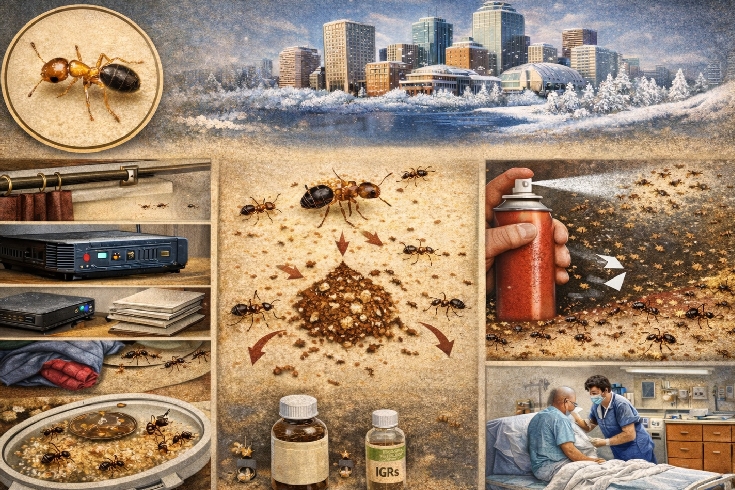
Experts regularly discover nests in places that the majority of homeowners would never look for:
- Inside the curtain rod’s hollow spaces.
- In between stacks of paper or book pages.
- Inside internet routers and outlets (attracted to the heat produced by the electronics).
- In the creases of sheets or clothes in storage.
- Behind window casings and baseboards.
They are a common problem for Edmonton’s transient rental population because they have a tendency to nest in moving objects, which means they are regularly moved between residences during moves.
The “Budding” Mechanism: Why Spraying Backfires
The reproductive strategy of Pharaoh ants is the most significant biological distinction between them and other species. The majority of ants breed by “nuptial flights,” in which males and winged queens take off to establish a new colony. Seldom do pharaoh ants swarm. Rather, they employ a technique known as budding.
A polygynous colony of Pharaoh ants has several queens, sometimes hundreds. The queens do not wait for a threat to pass when the colony perceives one, such as the use of a repellent spray or an abrupt temperature change. Rather, the colony breaks apart. A team of workers and some of the larvae will physically relocate one or more queens to a new, safer area of the building.
The Repellent Trap
Pyrethroids are present in the majority of over-the-counter sprays sold in hardware stores in Edmonton. These “repellent” pesticides are made to kill insects instantly and form a chemical barrier that they can’t penetrate.
The foragers are killed when you spray a line of Pharaoh ants on your kitchen counter. Still, the colony behind the wall is alerted to a potentially fatal situation—the colony buds in response. Three or four satellite colonies are dispersed throughout the kitchen, pantry, and restrooms, all originating from the single nest behind your dishwasher. Well-meaning do-it-yourself projects frequently result in a localized issue turning into a building-wide infestation by the time a professional is called.
Identification: Verifying the Species Before Taking Action
The key to successful pest management is accurate identification. It is worse to treat Pharaoh ants incorrectly than to do nothing at all.
Physical Attributes
With an average length of 1.5 to 2 millimeters, pharaoh ants are incredibly tiny. They frequently resemble moving dust particles or “ghost ants” to the unaided eye. Their coloration is clearly visible under a magnifying glass: a pale honey-yellow or golden-brown body with a distinctly darker, nearly black, abdomen.
Behavioral Measures
Pharaoh ants are most likely to be seen trailing behind refrigerators, next to heating vents, or near hot water pipes. Bathrooms and laundry rooms are the main hotspots because of their high moisture requirements. The trails of Pharaoh ants are frequently slender and irregular, following structural lines such as the edges of tiles or electrical wiring, in contrast to other species that march in thick, conspicuous columns.
| Features | Pharaoh Ant | Pavement Ant | Carpenter Ant |
|---|---|---|---|
| Size | 1.5 – 2 mm | 2.5 – 4 mm | 6 – 12 mm |
| Color | Honey yellow or golden | Black to dark brown | Solid Black |
| Nesting Site | Paper, electronics, wall voids | Soil and beneath concrete | Damp or decomposing wood |
| Reaction to Stress | Budding (Colony splitting) | Death/Retreat | Death/Retreat |
Why Hardware Store Baits Often Don’t Work
When homeowners find that spraying isn’t working, they frequently use store-bought baits. Although baiting is the best general strategy, there are two main reasons why consumer-grade products frequently don’t work to get rid of Pharaoh ants:
1. Cycle of Diet
Being extremely picky, pharaoh ants adjust their dietary requirements according to the needs of the colony. The colony occasionally requires high-protein sources to sustain the larvae’s growth and the queens’ reproductive well-being. At other times, they need carbohydrates to keep the workers going. Many retail baits are made entirely of sugar. They will ignore the bait if the colony is in a protein-seeking phase, giving the homeowner the impression that the infestation has disappeared when it is actually just foraging elsewhere.
2. The Kill’s Velocity
A slow-acting bait is essential for success. Trophallaxis, or communal feeding, is the process by which the worker consumes the bait, returns to the nest, and distributes it to the queens and larvae. A lot of consumer baits kill the worker ant before it can return to the nest because they are too “hot.” The colony will merely produce more workers to replace the ones you killed if the queens do not eat the bait, creating a cycle of brief suppression followed by a resurgence.
The Expert Method for Eliminating Pharaoh Ants
Pharaoh ant eradication necessitates a methodical, multi-phase strategy that puts colony collapse ahead of quick, visible kills. Edmonton’s professional exterminators employ equipment and methods that the general public cannot access.
Chemistry That Is Not Repulsive
Non-repellent insecticides are used by experts. Ants cannot detect these products. Unaware that they are ingesting a deadly dose, workers move through treated areas, dispersing it throughout the colony. By doing this, the “alarm” reaction that starts budding is avoided.
Insect Growth Regulators (IGRs)
Insect Growth Regulators are among the best tools for managing Pharaoh ants professionally. IGRs serve as the colony’s method of birth control. Instead of killing adult ants, they sterilize the queens and disrupt the larvae’s development.
The colony’s capacity to replenish its aging population is stopped when an IGR is introduced. Since no new workers or queens are produced to maintain the population, the colony gradually dies off over a period of weeks.
Bait Matrix Rotation
Usually, a certified technician will switch between various bait matrices with various attractants (proteins, fats, and sugars) such as liquids, gels, and granules. The technician guarantees that the colony will locate and eat the bait regardless of where it is in its nutritional cycle by providing a “buffet” of options.
Hazards to Property and Health
More than just an annoyance, pharaoh ants pose a health risk, especially in Edmonton’s food service and medical industries.
Transmission of Pathogens
Pharaoh ants can enter nearly any container due to their tiny size, including sterile medical supplies and “sealed” food packages. They are recognized as carriers of several dangerous infections, such as:
- Salmonella
- Staphylococcus
- Clostridium
- Streptococcus
They spread from trash cans and drains to food-preparation surfaces in homes, contaminating everything they come into contact with.
Healthcare and Multi-Unit Housing Challenges
Pharaoh ants present a special risk in medical hospitals and assisted living facilities. They are drawn to surgical wounds, IV bags, and even sleeping patients’ eyes because of their moisture content. Once they have taken root in the wall voids, they are almost impossible to keep in a single room due to their ability to travel through even the smallest cracks.
The “budding” behavior in apartment buildings means that if one tenant sprays their unit, the ants will probably be forced into the nearby units. As a result, the infestation spreads from suite to suite in a “ping-pong” pattern that won’t be eliminated until the entire building is systematically treated.
What to Anticipate from a Professional Intervention
The procedure is systematic when you hire a professional for Pharaoh ant control in Edmonton.
- Site Assessment: To determine the main “hubs” of activity, the technician will map the trails. This frequently entails examining heat sources such as electrical panels, hot water tanks, and dishwashers.
- Strategic Baiting: Ants forage in specific areas where baits are positioned. Ant activity often increases right after treatment. This is encouraging because it shows that the ants are successfully attracting more of their own kind to the bait source.
- The “No-Clean” Zone: Because bleach and cleaning products can act as repellents and make ants less likely to accept the bait, you will be told not to use them close to the bait sites.
- Monitoring and Follow-up: A second or third visit is frequently necessary to guarantee complete eradication due to the complexity of their colonies. During these visits, the technician may change the bait type to accommodate changes in the colony’s nutritional requirements.
Keeping the Environment Ant-Free
After the colony has been successfully collapsed by professional treatment, prevention takes precedence.
- Close the envelope: Fill in the spaces around baseboards, outlets, and plumbing penetrations with caulk based on silicone.
- Control the Moisture: Repair any leaking pipes or faucets. Because pharaoh ants require a steady supply of moisture to survive, make sure bathrooms have adequate ventilation.
- Airtight Storage: Put pantry items in glass or hard plastic containers that have airtight lids. Thin cardboard and plastic bags are easily chewed by pharaoh ants.
- Sanitation: Clean kitchen surfaces of any remaining sugar and grease. A tiny grease spill behind a stove can supply enough calories to keep a satellite colony going for weeks during a winter in Edmonton.
The only effective way to deal with pharaoh ants is professional intervention. A bigger, more costly, and more pervasive infestation is typically the outcome of trying to address the issue with retail products.
Commonly Asked Questions
In actuality, this indicates that the treatment is effective. The baits are more enticing than the food in your pantry because they contain pheromones and premium attractants. To return the bait to the queens, the ants are "recruiting" their nestmates to it. Since these ants deliver the treatment to the colony's center, you mustn't kill or disturb them.
Repellants include strong-smelling ingredients like vinegar, peppermint oil, or cinnamon. They do not eradicate the colony, but they might momentarily remove ants from a particular counter. These potent smells can actually serve as a stressor for Pharaoh ants, causing them to burrow deeper into your walls and spread to other rooms.
Eliminating pharaoh ants involves attrition rather than a quick kill. A colony usually collapses completely in three to six weeks. This schedule is required to guarantee that the workers have enough time to give each queen and larva in the network the slow-acting bait and Insect Growth Regulators.
Small amounts of professional gel baits are placed in crevices, cracks, and other places that dogs and cats cannot reach. Baiting is a highly targeted method that maximizes the effect on the target pest while minimizing the amount of product in the environment, in contrast to broad-spectrum sprays.
This typically occurs for one of two reasons: either a larger infestation in a nearby apartment or townhome has re-invaded your space, or the original colony was only suppressed and not completely eradicated (a common occurrence with do-it-yourself baiting). For a long-term solution in multi-unit buildings, coordinated treatment of all connected units is frequently required.