
Few things spark instant panic quite like the thought of bed bugs. One minute you are sleeping soundly; the next, you’re waking up with itchy welts and a sense of dread.
The stigma surrounding these pests is heavy, but here is the truth: bed bugs don’t care how clean your house is. They are master hitchhikers, looking for a ride and a blood meal regardless of whether you live in a luxury suite or a modest apartment.
The difference between a minor nuisance and a full-blown, multi-thousand-dollar infestation often comes down to one thing: speed. If you suspect you have unwanted guests, you cannot afford to wait. This guide covers the top 5 red flags to help you identify bed bugs early, saving your home, your sanity, and your wallet.
Why Detecting Bed Bugs Early Is Critical
Bed bugs are prolific breeders. A single female can lay up to five eggs a day. In favorable temperatures, a small introduction of just two bugs can explode into an infestation of thousands within a few months.
Detecting them early is critical for:
- Cost Efficiency: Treating a single room is significantly cheaper and less invasive than whole-house fumigation.
- Psychological Peace: Prolonged infestations often lead to severe anxiety and “insomnia-by-association.”
- Containment: The longer they stay, the further they travel—moving through electrical outlets and baseboards to infect other rooms or neighboring apartments.
Red Flag #1:
Waking Up to “Breakfast, Lunch, and Dinner” Bite Patterns
For many, the first sign of trouble isn’t seeing a bug it’s feeling the aftermath. While waking up itchy doesn’t automatically mean bed bugs, the arrangement of the bites is a major clue.
Bed Bug Bites vs. Mosquito or Flea Bites
Bed bug bites are notoriously difficult to diagnose because everyone reacts differently. However, professionals look for a specific layout:
- Bed Bugs: They tend to feed in a linear or zigzag pattern. Pest control experts often call this “breakfast, lunch, and dinner.” Bites usually appear as flat or raised red welts.
- Mosquitoes: These bites appear randomly over the body, are usually puffy, and itch almost immediately.
- Fleas: Fleas almost exclusively target the ankles and lower legs. Their bites are small, often have a central red spot, and are intensely itchy.
- Common bite locations: Bed bugs are “lazy” feeders and rarely burrow under tight clothing. Look for bites on exposed skin such as the face, neck, arms, and hands.
Red Flag #2:
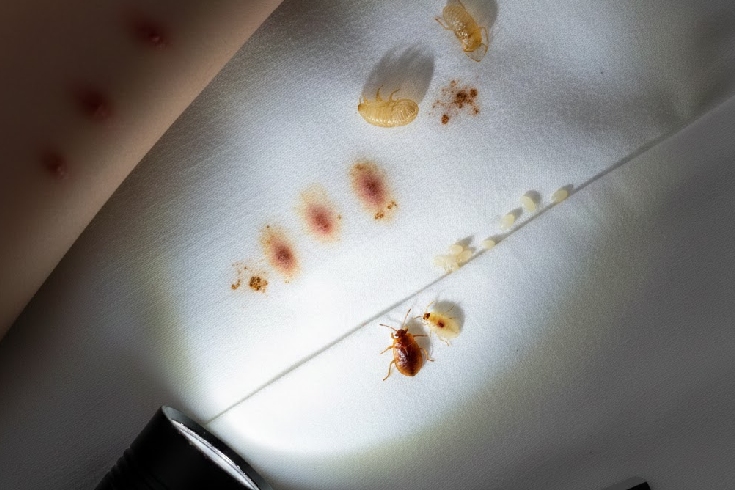
Rusty or Dark Fecal Spots on Sheets
If you are among the 30% of people who do not react to bed bug bites, your bedding will provide the evidence.
Recognizing “Marker” Stains
Look for small, rusty, or reddish-brown dots on your sheets, pillowcases, or mattress. These are not blood stains from the bite itself; they are fecal spots containing digested blood.
- The “Smear Test”:* On fabric, these spots look like a felt-tip marker was touched to the material, “bleeding” slightly into the fibers. If you find these spots, try wiping them with a damp cloth. If they smear or smudge, it is a definitive sign of bed bug activity.
Red Flag #3:
Finding Discarded Shell Casings (Exoskeletons)
As bed bugs grow, they pass through five nymphal stages. To progress to the next stage, they must molt, shedding their exoskeleton. Finding these “ghost bugs” is a sure sign of a maturing population.
Where to Look for Casings
These casings are translucent, pale yellow-brown, and shaped exactly like the bug. Because they are light, they often accumulate in:
- Crevices of mattress piping.
- Underneath the box spring.
- Along the gap between the baseboard and the floor.
Red Flag #4:
Spotting Tiny White Eggs and Eggshells
Finding eggs is the hardest red flag to spot, but it confirms an active breeding cycle. Bed bug eggs are tiny—about 1 millimeter long (roughly the size of a grain of salt).
- The Sticky Factor:* Unlike crumbs or lint, bed bug eggs are coated in a sticky substance that glues them to surfaces. If you see white specs in the seams of your mattress that don’t move when you brush them, use a magnifying glass. If they are oval and pearly white, you have a breeding population.
Red Flag #5: Seeing Live Insects
If you see a live bug, the infestation has likely moved past the “early” stage. However, panic often leads to misidentification. Use the chart below to ensure you aren’t looking at a common beetle.
Physical Characteristics
- Adults: Reddish-brown, wingless, and flat (similar to an apple seed). After feeding, they become elongated, balloon-like, and bright red.
- Nymphs: Nearly translucent or whitish-yellow, making them almost invisible against white sheets unless they have recently fed.
Comparison: Bed Bug vs. Lookalikes
| Feature | Bed Bug | Flea | Carpet Beetle |
|---|---|---|---|
| Shape | Oval, Flat (Apple seed) | Narrow, laterally flat | Round/Oval |
| Movement | Crawls (Medium speed) | Jumps | Crawls (Slow) |
| Legs | 6 Legs | 6 Legs (large rear legs) | 6 Legs |
| Primary Sign | Bites in lines | Bites on ankles | No bites (hair causes rash) |
Expert Tips: How to Inspect Your Home Like a Pro
To find bed bugs, you need a high-powered flashlight and a “crevice tool” (a stiff credit card or an index card).
- The Mattress Flip: Strip the bed. Use the card to lift the mattress piping (the raised edge). Run your flashlight along the seams. Check the manufacturer’s tags—bugs love to hide behind the labels.
- The Box Spring “Living Room”: Flip the box spring. Bed bugs often hide inside the plastic corner guards or under the dust cover (the thin fabric stapled to the bottom).
- The 5-Foot Radius: 80% of bed bugs live within 5 feet of the bed. Check the drawer joints of nightstands, behind headboards, and even inside the screw holes of bed frames.
I Found Signs of Bed Bugs: What Should I Do?
First, do not panic and do not move to the couch. If you move rooms, the bed bugs will follow your carbon dioxide trail, spreading the infestation to the rest of the house.
Immediate Containment Steps
- Heat Treatment: Gather all bedding and clothing. Wash in hot water and dry on the highest heat setting for at least 30 minutes. Heat is the most effective way to kill all life stages, including eggs.
- Vacuum Thoroughly: Use a vacuum with a HEPA filter on all seams and baseboards. Immediately empty the canister into a sealed bag and take it to an outside bin.
- Professional Assessment: While DIY sprays exist, they often cause bed bugs to scatter deeper into the walls (a phenomenon called “flushing”).
- Don’t let a small problem become a disaster. [Contact our team today for a professional inspection*] and reclaim your home.
Conclusion: Stay Vigilant
Bed bugs are resilient, but they are not invincible. By recognizing the early warning signs—linear bites, fecal spotting, and shell casings—you can act before the problem spirals. Make a quick inspection part of your routine whenever you change your sheets.
Frequently Asked Questions
Yes. Adult bed bugs are the size of apple seeds. However, eggs and nymphs are much harder to see without a flashlight.
According to the CDC, bed bugs do not transmit diseases. However, their presence can lead to secondary skin infections from scratching and significant psychological stress.
Usually through travel (luggage), used furniture, or shared walls in apartments. It has nothing to do with cleanliness.
No. While they prefer the dark, bed bugs will feed during the day if they are hungry enough. Lights will not deter an infestation.