Living in Edmonton is about dealing with really cold and really hot weather. We go from freezing in January to sweating in July. This big change in temperature affects how we live our lives, and it also affects the bugs and animals that live around us. For example, mice might try to get into a house in Glenora to get warm, or mosquitoes might show up at a barbecue in Terwillegar. These kinds of pests are something we have to put up with in the Edmonton area.
The time when people used to spray a lot of chemicals everywhere is coming to an end. Nowadays, Integrated Pest Management is the way to go. Integrated Pest Management is a process where people use science and their own judgment to deal with pests. It is not about getting rid of bugs; it is about figuring out why the bugs are there in the first place and changing the environment so the bugs cannot survive. Integrated Pest Management is about using biology to control pests, not just relying on chemicals. This means people have to think about why Integrated Pest Management is important and how it can help them.
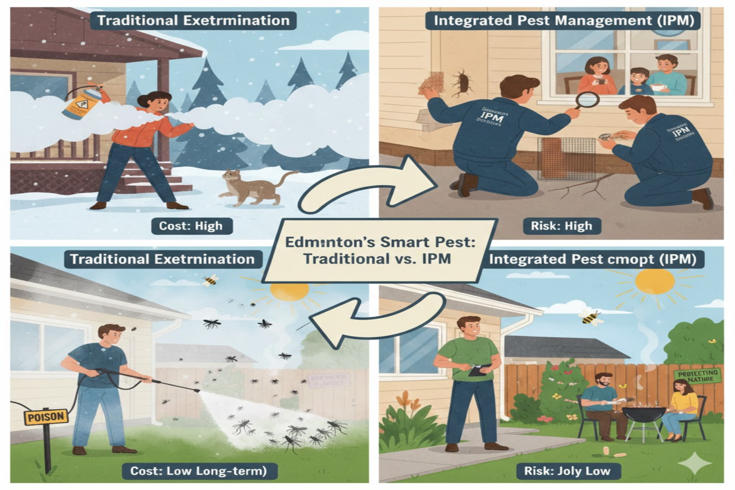
Traditional Extermination vs. IPM in Edmonton
When we try to get rid of pests, it usually goes like this: we see a bug, we spray the bug, and then we hope the bug does not come back. This method might make the problem go away for a while, but it does not really fix the problem with the pests. The pests are still a problem. The bug is still an issue. We are still dealing with the bug and the pests.
Integrated Pest Management is a process that happens over and over; it is not something that you do just once. When we think about Integrated Pest Management in a place like Edmonton, we have to consider the conditions there. Integrated Pest Management is about finding out what the problem is, keeping an eye on it, and stopping it before we use any chemicals to fix it.
The Traditional Approach
People usually do this by using something called “calendar spraying”. This means they apply treatments at times of the year, regardless of whether they see any pests or not. The problem with this approach is that it only deals with the issue, which is the pest that you can see. It does not really solve the problem, which is how the pests are getting in or what they are eating.
The IPM Approach
This method is about figuring out why pests are around. Are mice getting into the basement because of a crack in the foundation that lets in air? Is water sitting in the eavestroughs causing mosquitoes to breed? The people who do Integrated Pest Management are like detectives. They try to understand the life of the pest and how it interacts with the world around it. Then they use that information to develop solutions that will really last. In a place, like Edmonton, where the weather makes pests want to come looking at the structure of the building and the biology of the pest is the only way to get rid of them for good. Integrated Pest Management professionals do this every day in Edmonton, where weather drives pests indoors, and this is the way to ensure lasting relief from pests.
The Benefits of a Science-Based Strategy
Using science to manage property is a way to do things. For people who own homes in Edmonton and for people who manage businesses using Integrated Pest Management is an idea. It works a lot better than spraying stuff everywhere and hoping it works. Integrated Pest Management is a choice because it really gets the job done.
The main advantage of this is sustainability. We need to stop using many pesticides because they hurt our local ecosystem, from the North Saskatchewan River valley to the parks in our neighborhoods.
IPM is also better for our budget in the run. If we fix a problem with a building, it costs money one time. If we do not fix the problem, we will have to pay for sprays every month, which will cost us money. Sustainability is very important here.
Comparison: Traditional vs. IPM
Feature | Traditional Extermination | Integrated Pest Management (IPM) |
Primary Goal | Eradication via chemicals | Long-term prevention and management |
Strategy | Reactive (wait for bugs to appear) | Proactive (prevent entry and breeding) |
Chemical Use | High volume, broad-spectrum | Targeted, low volume, only when necessary |
Long-term Cost | High (recurring treatments) | Lower (solves the root cause) |
Risk Profile | Higher risk of exposure | Minimal risk to non-target organisms |
Safety for Pets and Families
Safety is the primary concern for families in residential hubs like Mill Woods or Summerside. IPM is significantly safer than traditional chemical bombardment.
The people who do Integrated Pest Management or IPM they try to use things like traps and keep places clean first. They do this so they do not have to use chemicals much. When they do need to use products they pick the ones that’re not as bad for people and pets. For example, if you have ants in your kitchen, the IPM person will not just spray everything. Instead they will use a kind of bait that is safe and put it in places where kids and pets cannot get to it like in cracks and crevices. This way, your home is still a place for your family, but it is not a good place for pests, as IPM targets the pests.
Implementing IPM in Edmonton Homes
Implementing IPM at home starts with inspecting your property through the eyes of a pest.
The freeze and thaw cycle is really bad for the outside of homes. It makes gaps around the pipes and windows. You should seal these gaps away. This is important for the home exteriors because the freeze-thaw cycle can cause a lot of damage. Seal the gaps, around the pipes and windows to protect the home exteriors.
Sanitation: Pests need water and food to survive. If you have a pipe somewhere, it’s like sending them an invitation to come on over. The same thing goes for a bag of dog food in the garage. Pests will find that bag of dog food and think they have hit the jackpot. So we need to make sure we do not have any pipes or open bags of dog food lying around because pests need water and food, and we do not want to give it to them.
Monitoring: Watch for droppings or gnaw marks to catch issues early.
If you see something going on, you should get a professional to come and look at the spots, in the defense of your home. They can figure out where your home’s defense is weak. Your home’s defense needs to be strong so you can feel safe. If your home’s defense has points, you need to fix them.
If you want to know more about the Residential Pest Control Services we offer, you can click on this link to learn more about our Residential Pest Control Services.
Humane Wildlife Exclusion
When it gets cold in Alberta, field mice, deer mice, and squirrels look for a place to stay for the winter. Field mice, deer mice, and squirrels really like attics and basements because they are warm and cozy.
The old way of controlling pests often uses poison. This method works. It can also hurt other animals, like owls or your own cat.
A better way is to use something called Integrated Pest Management. This method focuses on keeping the pests out.
We look for holes as small as a dime, where the pests are getting in. Then we seal these holes with materials that the pests cannot chew through.
By doing this, we can get rid of the pests for good without putting poison around your home.
Heat Treatment for Bed Bugs
Bed bugs are a problem in big cities, and Edmonton has them too. These little bugs are really hard to get rid of because they are not affected by many of the bug killers that people use. Bed bugs have gotten used to these bug killers, so they do not work on bed bugs anymore.
Science-based IPM offers a solution: Heat. No matter what, bed bugs just cannot survive high or really low temperatures. So we use Heat treatment, which means we raise the room temperature so high that it kills the bed bugs and their eggs. It is still safe for our belongings. This is a way to use Science-based IPM because it uses physical things, like temperature, to stop the bed bugs from living and breeding, and it does this right away without leaving any bad chemicals on our furniture. Science-based IPM, such as heat treatment, can help eliminate bed bugs.
Sustainable Mosquito Management
Edmonton summers are really short. They are very beautiful. However, mosquitoes can be a problem, making our backyards unbearable. When we use an Integrated Pest Management approach, it helps us avoid using blanket fogging that can harm bees and butterflies. This way, we can still enjoy our backyards. Also, take care of the bees and butterflies in Edmonton during the summer.
We look at the mosquito’s stage. This is when we find out where water is standing, like in bird baths or gutters that are clogged or low spots, in the lawn. Then we treat these areas with medicines that kill the mosquito larvae. These medicines are found in nature, and they only hurt the mosquito larvae; they do not hurt insects. If we stop the larvae before they can fly, there will be fewer mosquitoes that bite.
Commercial IPM for Food Facilities
For restaurants and food processing facilities in Edmonton, pest control is about compliance with Alberta Health Services (AHS).
Commercial IPM is about using data to make decisions. It involves keeping track of everything that happens, looking at trends, and making maps of what’s going on. For example, if a restaurant on Whyte Avenue starts to see a lot of fruit flies, the Commercial IPM technician does not just spray something to make them go away. They try to find out what is causing the problem, like produce that is rotting or a drain line that is clogged. Working with a Commercial IPM provider who knows about audit standards can help prevent infestations of Commercial IPM. This is important because infestations can lead to reviews or even the closure of the restaurant.
To get help with pest control for your business, you can click here to get a quote for pest management.
Municipal IPM: The City of Edmonton and Dutch Elm Disease
The City of Edmonton really likes Integrated Pest Management. It is not just used for property. The City of Edmonton uses Integrated Pest Management a lot, especially when it comes to the trees in our city. The City of Edmonton has a lot of American Elm trees that are very healthy and do not have Dutch Elm Disease. In fact, Edmonton has one of the groups of healthy American Elm trees in the world that are not infected with Dutch Elm Disease.
The city is doing a job, and this is because of IPM. They have a system to keep an eye on things. The city uses traps that have pheromones to catch the elm bark beetles that carry the bad fungus.
They also do not let people prune trees between April 1 and September 30. This is because the beetles are most active during these months—the beetles like the smell of cuts on trees.
The City is able to take care of our trees and keep them healthy without using a lot of fungicides. They do this by knowing how the beetles and trees work. This way, the city can preserve our trees. Keep the area nice. IPM is really helping the city to do this.
Conclusion
Pest control is not what it used to be. Nowadays, it is not about using chemicals to get rid of pests. Instead, pest control is about having a plan to deal with the problem. If you have bed bugs in your apartment, mice in your house, or if you need to protect a kitchen from pests, Integrated Pest Management is a good way to go. It is safe, for people and the environment it works well. It is a long-term solution. Integrated Pest Management is what you need to get rid of pests and keep them away.
Living in Edmonton means you have to deal with nature all the time. That does not mean you should let nature take over your home. When you choose to do things in a way that is based on science, you are protecting your property and your health. This way, you can keep your home safe from nature. Keep yourself healthy at the same time.
Frequently Asked Questions
No, it may cost more initially but saves money long term.
Results can appear in days, with full control taking weeks or months.
Usually no, except for special treatments like heat or heavy chemicals.
Yes, IPM is highly effective for keeping winter pests out.